USAID DEC
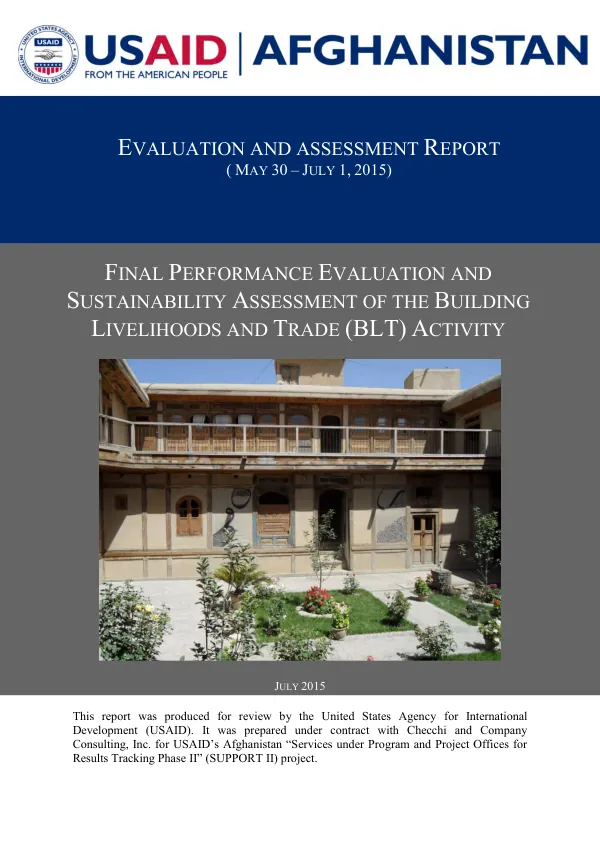
Final Performance Evaluation and Sustainability Assessment of the Building Livelihoods and Trade (BLT) Activity
Sign inCHECCHI AND COMPANY, CONSULTING, INC.
Final Performance Evaluation and Sustainability Assessment of the Building Livelihoods and Trade (BLT) Activity
The Building Livelihoods and Trade (BLT) Activity was initiated by the Office of Program and Project Development (OPPD) through Mr.
2015 · 74 pages
Sign in to readA free account is required to download.
Abstract
Daryl Martyris, COR/SUPPORT II, in May 2015. The activity aimed to evaluate the achievements of the Turquoise Mountain Trust (TMT) over the seven years it had benefited from USAID funding and assess the sustainability of its operations. The review team investigated the work of the Turquoise Mountain Institute (TMI), where craft training takes place, surveyed the area of Murad Khane, where TMT has undertaken urban renewal projects, and met with employers and customers of TMT to evaluate their satisfaction with the skills of TMI graduates and the quality of TMT products and artifacts. The Turquoise Mountain Trust, a British-registered non-profit organization, was founded in 2006 with the vision of restoring the historically and architecturally significant community of Murad Khane in central Kabul and revitalizing traditional craft skills in Afghanistan. TMT assists the community with accessing healthcare and primary education and promoting Afghan arts and craft. The Trust has established a training establishment, the Turquoise Mountain Institute (TMI), to train young people in areas such as woodwork, ceramics, calligraphy, and miniature painting, and jewelry and gem-cutting. USAID has been supporting TMT since 2008, and in 2010, the program was renamed Building Livelihoods and Trade (BLT) with the aim of building economic and trade opportunities for Afghans, providing traditional craft education through TMI, and developing the market for Afghan crafts domestically and abroad through business-development activities. The Total Estimated Cost (TEC) of funding the BLT through TMT since 2008 amounts to $10,637,111. Three of the elements—urban regeneration, community development, and business development—were completed in July 2011, leaving only the fourth element—education—for continued support to the end of the program in November 2015. The evaluation questions were framed to tackle each of the two parts of the investigation separately and distinctly, while recognizing the overlap between what has been achieved at TMT and what is planned for the future. The research design included a mixed-method approach, beginning with a literature review and a critical analysis of documentation provided by TMT and USAID. The data-gathering exercises adopted both quantitative and qualitative methodologies, including financial records analysis, surveys of students, graduates, and community members, individual interviews with key stakeholders, and focus group discussions. The review team found that the Turquoise Mountain Institute (TMI) has been successful in training young people in traditional craft skills, with over 1,000 graduates having completed the program since its inception. The graduates have gone on to start their own businesses, with many achieving significant success. The TMI graduates have also been employed by local businesses, with some earning higher wages than their peers. The review team also found that the TMT products and artifacts have been well-received by customers, with many expressing satisfaction with the quality and craftsmanship. The review team identified several challenges facing TMT, including limited access to funding, a lack of infrastructure, and a shortage of skilled trainers. However, the team also noted that TMT has made significant progress in addressing these challenges, including the establishment of a new training center and the recruitment of additional trainers. The review team recommended that TMT continue to focus on building its capacity and expanding its reach, while also exploring new opportunities for funding and partnership. The review team also assessed the sustainability of TMT's operations, finding that the organization has made significant progress in this area. The team noted that TMT has established a strong reputation in the community and has developed a robust business model. However, the team also identified several challenges facing TMT's sustainability, including the need for continued funding and the risk of donor fatigue. The review team recommended that TMT continue to focus on building its sustainability, including through the development of new funding streams and the establishment of partnerships with local businesses and organizations. Overall, the review team found that the BLT Activity has been successful in achieving its objectives, including the training of young people in traditional craft skills and the development of the market for Afghan crafts. The team also found that TMT has made significant progress in addressing the challenges facing the organization and has established a strong foundation for its sustainability.