CHECCHI AND COMPANY, CONSULTING, INC.
Verification Report: Emergency Textbook Distribution in Afghanistan
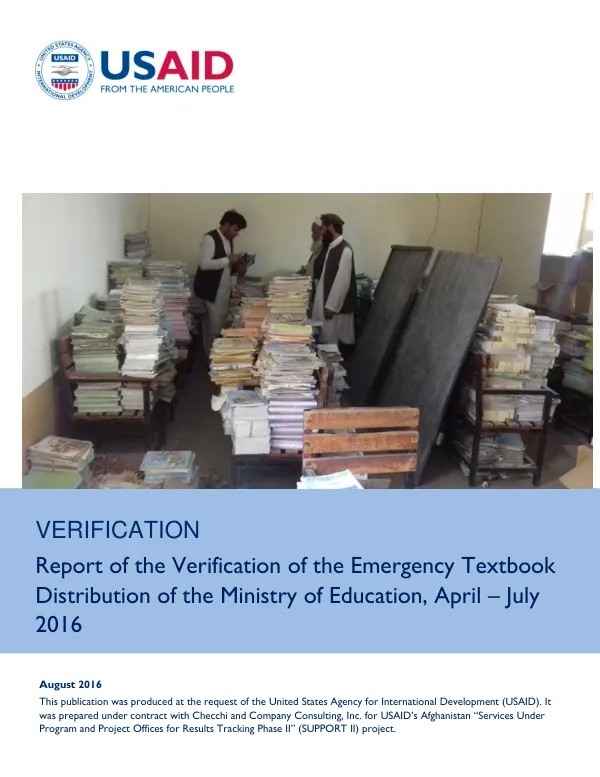
The emergency textbook distribution for grades 7-9 in Dari and Pashto in 12 provinces of Afghanistan was a USAID-funded initiative aimed at addressing the acute shortage of textbooks in the country.
2016 · 86 pages
Sign in to readA free account is required to download.
Abstract
The distribution plan was implemented by the Ministry of Education (MoE) in collaboration with the Provincial Education Departments (PEDs) and the District Education Departments (DEDs). The distribution process involved the requisition and delivery of textbooks to schools, with the goal of ensuring that students had access to the necessary learning materials. A sample of 2.2 million textbooks was tracked as part of the verification process, which aimed to determine the efficiency of the requisition and distribution process. The verification questions focused on the percentage of emergency textbooks requested that were actually received, the identification of inefficiencies in the process, and the impact of remoteness and insecurity on the distribution process. The verification process involved the collection of data from various sources, including school records, PED records, and DED records. The data was analyzed to determine the coverage of the sample, the books requested, received, and distributed, and the use of official forms by schools and PEDs. The analysis revealed that the distribution process was characterized by inefficiencies, including delays in the delivery of textbooks and discrepancies in the reporting of textbook distribution. The verification report highlights the challenges faced by the MoE and its partners in implementing the emergency textbook distribution plan. The report notes that the distribution process was affected by remoteness and insecurity, which hindered the delivery of textbooks to schools in some provinces. The report also identifies areas for improvement, including the need for better record-keeping practices and more efficient communication between schools, PEDs, and DEDs. The verification report provides a detailed analysis of the textbook distribution process, including the use of official forms, the requisition and delivery of textbooks, and the reporting of textbook distribution. The report also includes data on the coverage of the sample, the books requested, received, and distributed, and the use of textbooks by students. The report concludes that the emergency textbook distribution initiative has made significant progress in addressing the acute shortage of textbooks in Afghanistan, but that further improvements are needed to ensure the efficient and effective delivery of textbooks to schools. The report highlights the importance of effective planning and management in ensuring the successful implementation of the emergency textbook distribution plan. The report notes that the MoE and its partners must work together to address the challenges faced by the distribution process, including remoteness and insecurity, and to improve the efficiency and effectiveness of the distribution process. The report also emphasizes the need for better record-keeping practices and more efficient communication between schools, PEDs, and DEDs. The verification report provides a comprehensive analysis of the emergency textbook distribution initiative in Afghanistan, highlighting the challenges faced by the MoE and its partners and identifying areas for improvement. The report provides valuable insights for policymakers, educators, and development practitioners working in the education sector in Afghanistan.