CHECCHI AND COMPANY, CONSULTING, INC.
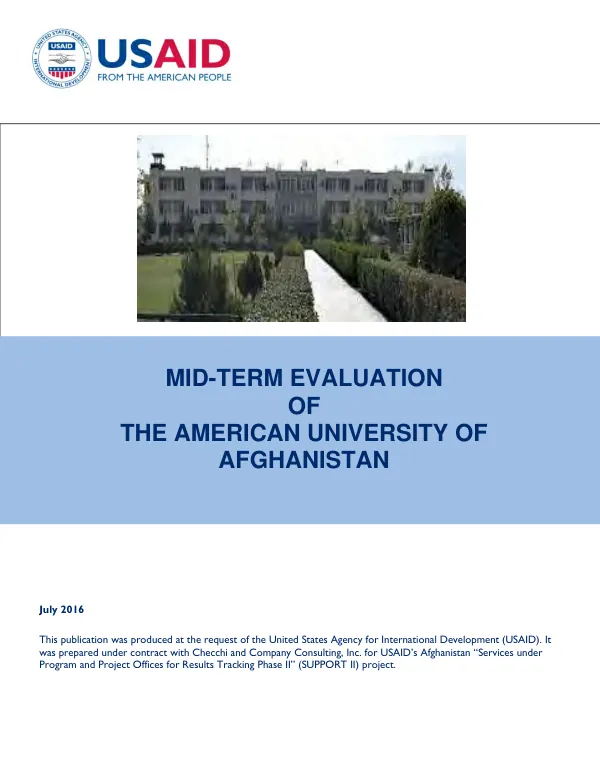
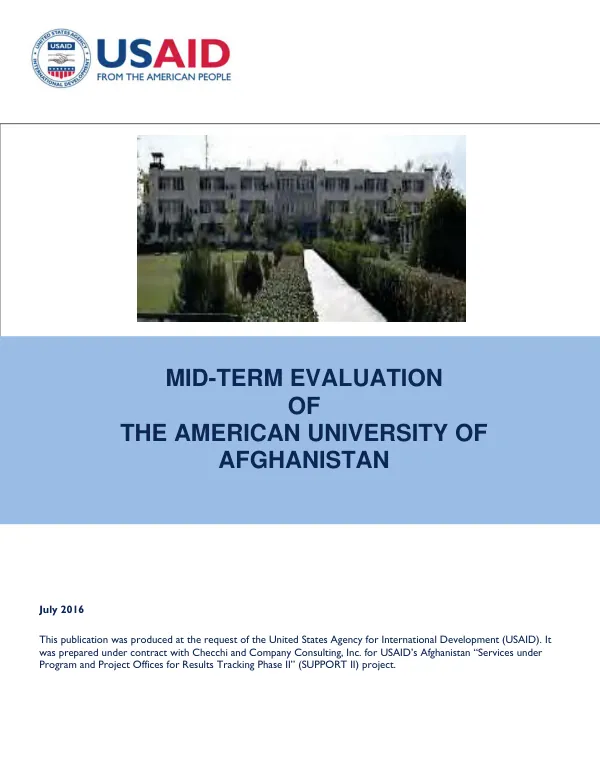
Mid-term Evaluation of the American University of Afghanistan
The American University of Afghanistan (AUAF) was chartered in July 2004 as an independent, private, non-profit, non-sectarian institution of higher education.
2016 · 63 pages
Sign in to readA free account is required to download.
Abstract
The university's first academic year was 2007-2008, and it offers undergraduate programs in business, information technology/computer science, political science and public administration, and law. In 2011, a Master's program in business administration (MBA) was introduced, and three years later, a Master's in Education program was run for the Ministry of Education, with World Bank funding. The university operates the Professional Development Institute (PDI), which provides professional training and certification programs for Afghanistan's growing number of professionals in both the public and private sectors. The PDI has campuses at Herat, Kandahar, Mazar-i-Sherif, and Jalalabad. In 2013, the Center for Afghan Women's Economic Development (ICAWED) was opened on the new AUAF International Campus, with the purpose of enhancing women's participation in the economy. Additionally, a Business Innovation Hub (BIH) was established at that time, with a mission to provide high-quality business management and leadership services to Afghan companies. A five-year cooperative agreement was signed between USAID and AUAF in 2013, covering the period August 01, 2013 to July 31, 2018, with a total estimated cost of $40 million. The agreement was increased in September 2015 to $45,902,538.00 and extended the end date of the agreement to November 30, 2019. The funds made available through this agreement cover a significant proportion of faculty and international staff salaries and various operating costs and security costs. The purpose of USAID funding is to support the permanent establishment of an American-style university in Afghanistan that will imprint values of academic freedom, high-quality instruction, research, academic honesty, work ethic, and community service to its graduates joining the national and international labor force. The evaluation of AUAF's mid-term performance was conducted through a mixed-methods approach, consisting of document review, focus group interviews, one-to-one interviews with key informants, and a critical evaluation of the findings from investigations, independent assessors, and evaluations, including an organizational capacity assessment by independent auditing organizations. The research questions addressed in the evaluation include the operational capacity and objectives being met, the effectiveness of student recruitment, retention, and progression into employment, the quality of financial management, and the university's capacity to achieve sustainability. The evaluation found that AUAF has made significant progress in its five program components and sub-components, focusing on the activities presented in the Statement of Work (SOW). The university has demonstrated a strong commitment to academic freedom, high-quality instruction, research, academic honesty, work ethic, and community service. However, the evaluation also identified key risk factors and provided recommendations to both USAID and AUAF for risk mitigation and technical improvement. The evaluation highlighted the importance of AUAF's role in promoting education and economic development in Afghanistan. The university's programs have contributed to the growth of a skilled and educated workforce, which is essential for the country's economic development. The evaluation also noted the need for AUAF to continue to improve its financial management and sustainability, as well as to address the challenges related to student recruitment, retention, and progression into employment. Overall, the evaluation of AUAF's mid-term performance provides a comprehensive assessment of the university's progress and challenges, and offers recommendations for improvement and sustainability. The evaluation highlights the importance of AUAF's role in promoting education and economic development in Afghanistan, and underscores the need for continued support and investment in the university's programs and activities.