CHECCHI AND COMPANY, CONSULTING, INC.
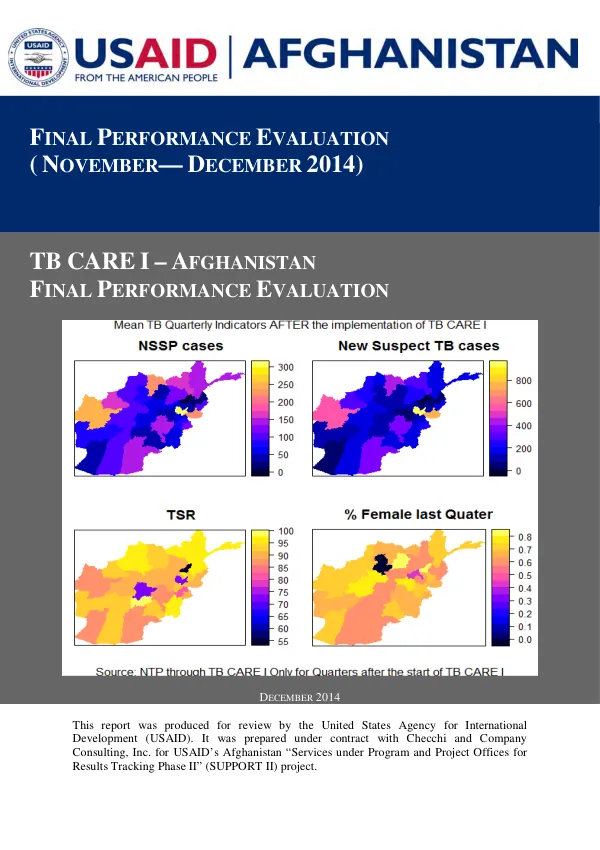
Final Performance Evaluation TB CARE I - Afghanistan
TB CARE I was a USAID-funded project aimed at improving tuberculosis (TB) control in Afghanistan.
2014 · 128 pages
Sign in to readA free account is required to download.
Abstract
The project was initiated by the Office of Program and Project Performance (OPPD) on November 10, 2014, and completed on December 22, 2014. The project was implemented by Checchi and Company Consulting, Inc. under contract number AID-306-C-12-0012. The project's main objective was to evaluate the performance of TB CARE I, a USAID-funded project that aimed to improve TB control in Afghanistan. The evaluation was conducted by a team led by Robert J. Haf, with team members Dr. Kayhan Natiq and Dr. Sayed Haroon Rastagar. The evaluation focused on assessing the project's progress, identifying areas for improvement, and providing recommendations for future TB control efforts in Afghanistan. The evaluation was conducted from November to December 2014, and the results were presented in a final performance evaluation report. The report highlighted the project's achievements, challenges, and challenges faced by the project team. The evaluation also provided recommendations for future TB control efforts in Afghanistan. TB CARE I was a community-based TB control project that aimed to improve TB detection and treatment in Afghanistan. The project was implemented in six provinces, including Kabul, and targeted a population of approximately 1.5 million people. The project's main interventions included the establishment of community-based TB clinics, the provision of TB diagnosis and treatment services, and the promotion of TB awareness and education. The project's evaluation revealed that TB CARE I made significant progress in improving TB detection and treatment in Afghanistan. The project's clinics detected and treated a significant number of TB cases, and the project's interventions led to a reduction in TB-related mortality rates. However, the project faced several challenges, including challenges related to TB diagnosis and treatment, as well as challenges related to the project's sustainability and scalability. The evaluation also highlighted the importance of community-based TB control efforts in Afghanistan. The project's community-based approach helped to increase TB awareness and education among the target population, and the project's interventions led to a significant reduction in TB-related stigma and discrimination. The evaluation provided several recommendations for future TB control efforts in Afghanistan. The recommendations included the need to strengthen TB diagnosis and treatment services, the need to improve TB awareness and education among the target population, and the need to increase community engagement and participation in TB control efforts. The evaluation also highlighted the importance of sustainability and scalability in TB control efforts. The project's interventions were designed to be sustainable and scalable, and the project's evaluation revealed that the project's interventions had a significant impact on TB control in Afghanistan. The project's evaluation was conducted in accordance with the USAID's evaluation policy, and the evaluation was designed to provide an objective and unbiased assessment of the project's performance. The evaluation was conducted by a team of experts, and the evaluation's findings and recommendations were presented in a final performance evaluation report. The project's evaluation provided several key findings and recommendations for future TB control efforts in Afghanistan. The evaluation highlighted the importance of community-based TB control efforts, the need to strengthen TB diagnosis and treatment services, and the need to improve TB awareness and education among the target population.
Related documents