USAID DEC
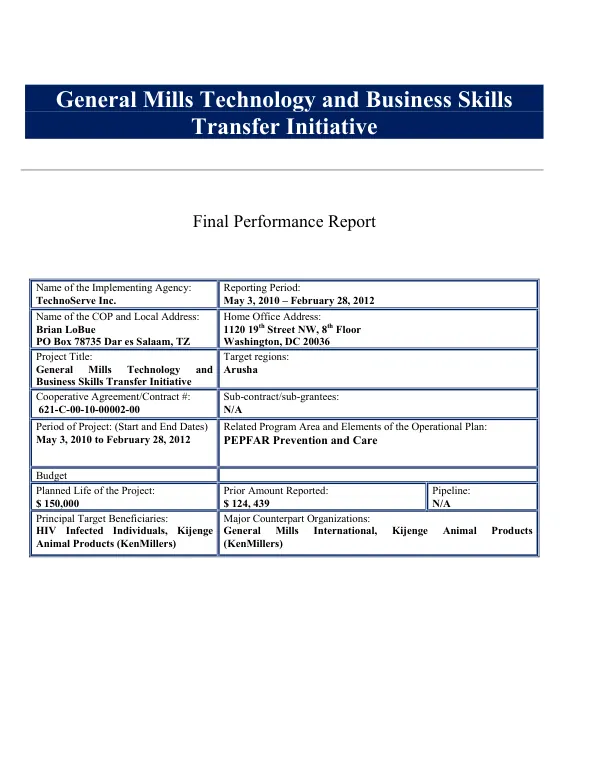
Final Performance Report: General Mills Technology and Business Skills Transfer Initiative
Sign inTECHNOSERVE, INC.
Final Performance Report: General Mills Technology and Business Skills Transfer Initiative
The General Mills Technology and Business Skills Transfer Initiative aimed to support USAID/Tanzania's response to the HIV/AIDS pandemic by providing fortified foods to HIV-infected individuals in Tanzania.
2012 · 223 pages
Sign in to readA free account is required to download.
Abstract
This project enabled General Mills International to assist a local miller, Kijenge Animal Products, to successfully conduct start-up activities for a fortified corn-soya blend (CSB) production line that meets WFP/TFDA/TBS fortification standards. The project's activities included supporting General Mills' transfer of technical knowledge to KenMillers personnel regarding production of CSB, conducting a baseline survey to gather information on smallholder farmers supplying crops to the miller, developing baseline information on the key points in the value chain, establishing relationships with key partners, and procuring and installing an extrusion cooker for Kijenge Animal Products. The procurement of an extrusion cooker was a critical activity undertaken for this project. TNS leveraged GMI's technical knowledge to evaluate candidate suppliers and selected InstaPro International, based in Urbandale, Iowa. The key criteria used for selection included quality of the extruder, cost of the extruder, and quality and proximity of regional support options. TNS ultimately procured a one metric ton per hour extrusion cooker from InstaPro, along with additional equipment such as spare parts, a partilizer cutter, water injection manifold, and a commissioning/training package. The project also involved identifying ancillary equipment required to bring the CSB line to fruition and meet the higher quality requirements of the food aid market. Engineers from General Mills and TNS worked with KAP to determine additional requirements, including an automated conveyor system, hammer mills, drum cooler, ribbon mixer, semi-automatic packaging machine, and a second extruder. Given the increased costs of procuring ancillary equipment, TNS worked with KAP on a phased approach to equipment procurement. TechnoServe also explored options to reduce the cost of investment required by using local fabricators for parts of the line. However, KAP preferred to continue with a 100% InstaPro line, with the exception of packaging equipment, which may be sourced from China or India. The project also discussed the possibility of producing other types of food products using the extruder to improve the project's economics in the early years. The project's geographic focus was Tanzania, with a specific emphasis on supporting HIV-infected individuals in the country. The project's timeframes were from May 3, 2010, to February 28, 2012, with a budget of $150,000. The principal target beneficiaries of the project were HIV-infected individuals, smallholder farmers, and Kijenge Animal Products. The major counterpart organizations involved in the project were General Mills International and Kijenge Animal Products. The project's achievements included the successful procurement and installation of an extrusion cooker, the identification of ancillary equipment required to bring the CSB line to fruition, and the exploration of options to reduce the cost of investment required. The project's lessons learned and recommendations included the importance of standardization, the need for phased equipment procurement, and the potential for producing other types of food products using the extruder.
Related documents