USAID DEC
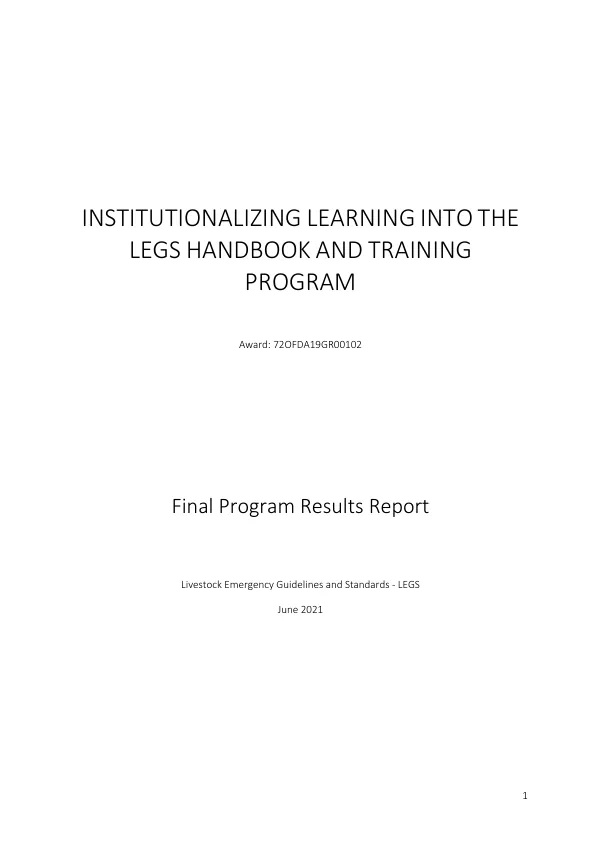
Final Program Performance Report: Institutionalizing Learning into the LEGS Handbook and Training Program
Sign inUSAID
Final Program Performance Report: Institutionalizing Learning into the LEGS Handbook and Training Program
The LEGS Handbook and Training Program institutionalized learning into the LEGS Handbook and Training Program.
2021 · 18 pages
Sign in to readA free account is required to download.
Abstract
The program aimed to ensure high standards of livestock-based emergency response, with benefits to both people and animals. The overall goal of the program was to make LEGS guidelines and support services globally used. Output 1: Institutionalizing Learning into the LEGS Handbook focused on gathering and analyzing information to be institutionalized into the LEGS approach and resources, particularly the LEGS Handbook. Activity 1.1, Updating the LEGS Evidence Database, involved a consultant reviewing relevant documentation to update the LEGS Evidence Database. The review included searching online databases and academic journals for new reports, evaluations, and journal articles. Five documents were added to the database, and a brief annotated bibliography was produced covering these documents and others of potential interest to LEGS. Activity 1.2, Review of Key Issues and Production of Briefing Papers, involved a review of current issues to incorporate internal and external learning into the production of the next edition of the LEGS Handbook. Eight Discussion Papers were commissioned on topics prioritized by the LEGS Advisory Group, including gender, nutrition and livestock, quality of veterinary medicines, and institutionalization and localization of LEGS. The papers were translated into French and Spanish, except for one. Output 2: Institutionalizing Learning into the LEGS Training Program focused on reviewing the LEGS Training Program and developing new mini-modules. Activity 2.1, Review of Training Program Learning, generated a range of useful recommendations for the short and long-term development of the Program. Activity 2.2, Development of New Mini-Modules, involved the development of three mini-modules, which were disseminated to LEGS Trainers for delivery alongside the standard 3-day LEGS Training. The original plan for a decentralized Training of Trainers (TOT) course was cancelled due to the COVID-19 pandemic, and a LEGS remote delivery course (RDC) was developed instead. Output 3: Sector Communication and Support involved ongoing communications with the LEGS Community of Practice, including LEGS Trainers who continued to roll out LEGS Training within the constraints of the COVID-19 pandemic. A total of 38 trainings were delivered during the award period, 13 in the last year. LEGS also continued to participate in key networks, including the Humanitarian Standards Partnership (HSP) and the global Food Security Cluster (gFSC). The activities were maintained and sustained by effective management and coordination, including seven online meetings of the LEGS Advisory Group. The program accomplishments were detailed according to the three output areas outlined above. The program activities made a significant contribution to the overall program goal, and the results from all the processes were collated and compiled in a Consolidation Report, which provides an invaluable resource for the revision and updating of the Handbook in the next phase. The review of the LEGS Training Program generated a range of useful recommendations for the short and long-term development of the Program. The program was supported and complemented by ongoing communications with the LEGS Community of Practice and participation in key networks.