DIGITAL GREEN FOUNDATION
Recommendations for Strengthening Local Extension & Advisory Services Capacity
The Developing Local Extension Capacity (DLEC) project was implemented from May 2016 to June 2021, with the goal of strengthening local extension and advisory services capacity.
2021 · 4 pages
Sign in to readA free account is required to download.
Abstract
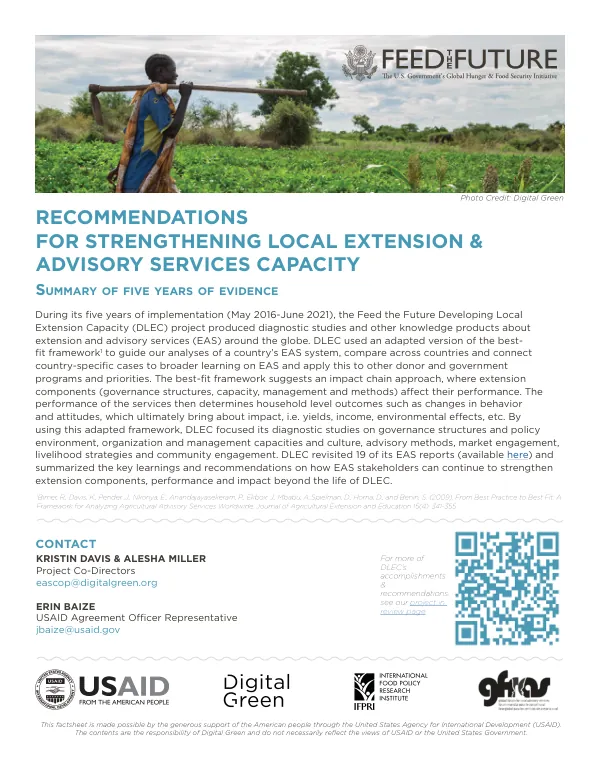
The project used an adapted version of the best-fit framework to guide its analyses of extension and advisory services (EAS) systems around the globe. This framework suggests an impact chain approach, where extension components affect their performance, which in turn determines household-level outcomes such as changes in behavior and attitudes, ultimately leading to impact. The DLEC project focused its diagnostic studies on governance structures and policy environment, organization and management capacities and culture, advisory methods, market engagement, livelihood strategies, and community engagement. The project revisited 19 of its EAS reports and summarized the key learnings and recommendations on how EAS stakeholders can continue to strengthen extension components, performance, and impact beyond the life of DLEC. One of the key findings of the DLEC project is that pluralistic EAS, which include government, donors, nongovernmental organizations, and the private sector, are more effective when all partners collaborate to achieve desired outcomes. Coordination is key to ensure synergy, avoid duplication, and ultimately support agricultural development. There is a trend toward privatization of sustainable business models, which requires service bundling given the poor track record of fee-for-extension models. Governments play a crucial role in creating the right enabling environment for pluralistic EAS to flourish. National agricultural extension policies are needed to promote collaboration, define roles and responsibilities, and better coordinate the activities of public and private extension and of nongovernmental organizations and donors. The DLEC project also emphasizes the importance of curriculum reform and tailoring to local context. EAS training curricula must be overhauled to be market-oriented, relevant, and inclusive of youth and women. Extension staff should be professionalized through in-service and continuing education as well as incentive systems. Curricula should include soft skills, business and market skills, and gender, youth, and nutrition-sensitive approaches. The project highlights the importance of including women in EAS, as women farmers have limited access to resources and opportunities. Studies have shown that targeting women within the household with extension information has a positive effect on different domains of empowerment, including women's knowledge of agronomic practices, participation in agricultural decision-making, and adoption of recommended practices and inputs. Engaging youth in EAS is also critical for livelihoods in rural areas where youth are unemployed and face barriers to entry into agriculture. The design of youth interventions should take youth heterogeneity into account, and interventions should include digital tools, given that youth tend to be familiar with these technologies. The DLEC project also emphasizes the importance of digital extension and ICTs, as mobile phone access and internet penetration grow. Local context, including levels of digital literacy, smartphone use, internet penetration, and cost of data plans, are critical to digital extension interventions. The use of ICTs should be inclusive and not prohibit those with poor access to digital tools or who lack digital literacy. Furthermore, the project highlights the need to integrate climate change programming in extension, as increased incidences of drought, floods, pest outbreaks, and natural disasters can be attributed to climate change. EAS should use climate-sensitive approaches and ensure that approaches build resiliency and mitigate climate change. Finally, the DLEC project emphasizes the importance of nutrition-sensitive extension approaches, as many smallholder and subsistence farmers may not have access to a diverse and nutritious diet. Extension can be an entry point to support nutrition outcomes, and extension agents should be provided with skills on nutrition-sensitive extension to support farmers who face food and nutrition insecurity. Monitoring, evaluation, and learning in extension are also critical, as monitoring and evaluation systems and the capacities to use them are important to track targets and understand the impact of EAS activities. Developing standardized metrics for extension is important but difficult because of the many contextual needs. Creating a dashboard or suite of options to choose from based on local context, rather than a subset of standardized metrics, could be effective.