USAID
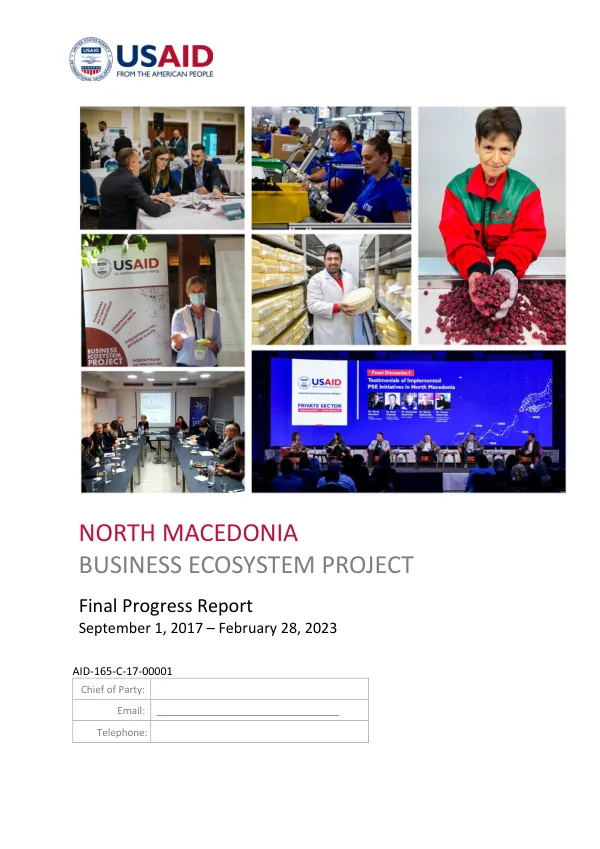
Final Progress Report: USAID Business Ecosystem Project in North Macedonia
The Business Ecosystem Project (BEP) in North Macedonia focused on three interconnected components to address key facets of the business ecosystem.
2023 · 54 pages
Sign in to readA free account is required to download.
Abstract
The project aimed to strengthen the sector providing services to Micro, Small and Medium Enterprises (MSMEs), alleviate issues MSMEs face in accessing finance, and facilitate market linkages through Private Sector Engagement (PSE). BEP's first component, Objective 1, focused on strengthening Business Support Organizations (BSOs) by building their internal capacity and facilitating the development of relevant and commercially viable services. Through two rounds of grant programs, BEP supported 14 BSOs, assisted them in increasing their membership by 108%, and facilitated the development and introduction of 86 new, sustainable services. Improved processes for the BSOs with which BEP cooperated totaled 108. This component accounted for 74% of all new jobs created. Objective 2 aimed to alleviate issues MSMEs face in accessing finance. The approach combined direct facilitation of Access to Finance (A2F) on a Pay for Results (P4R) basis using a network of financial facilitators (FFs) and promoting the utilization of existing and supporting the introduction of new financial products. BEP developed cooperation and trained 47 FFs and 17 Financial Institutions (FIs), developed a pipeline of 1384 financing projects, and facilitated $111.5 million in financing for MSMEs and startups. This component accounted for 20% of all new jobs created. The third component, Objective 3, focused on facilitating market linkages through PSE. BEP partnered with 53 lead companies, supported 344 MSMEs and beneficiaries through these co-investments, and leveraged investments of $13.2 million from lead firm and private sector partners. This resulted in a project life average of $10/$1 ratio of leveraged funds, meaning that every $1 of USG investment stimulated $10 of private sector investments. On a project level, 34% of all stakeholders included in BEPs programs designed to increase access to productive economic resources were female, and 21% of participants in BEP activities were female. The Business Ecosystem Project achieved significant results, surpassing targets set for the program. The project helped create 14,997 new jobs, generated a 23 percent average annual growth rate for all MSMEs BEP collaborated with, resulting in $2.5 billion in MSME revenue growth. BEP trained 3971 people in new skills, facilitated linkages to new buyers for 705 MSMEs, and assisted 5658 MSMEs with USG support. The project's success demonstrates the effectiveness of an integrated and innovative approach to addressing key facets of the business ecosystem. BEP's collaboration with various stakeholders, including BSOs, FIs, and lead companies, played a crucial role in achieving the project's objectives. The project's focus on PSE and A2F helped to address the issues MSMEs face in accessing finance and facilitated market linkages. The project's results demonstrate the potential for sustainable economic growth and development in North Macedonia. The Business Ecosystem Project's success has implications for future development initiatives in North Macedonia. The project's integrated and innovative approach can serve as a model for addressing key facets of the business ecosystem in other countries. The project's focus on PSE and A2F can help to address the issues MSMEs face in accessing finance and facilitate market linkages, leading to sustainable economic growth and development.