USAID DEC
Summative Performance Evaluation Of The Civic Engagement Project (CEP) In North Macedonia
Sign inIMPAQ INTERNATIONAL, LLC
Summative Performance Evaluation Of The Civic Engagement Project (CEP) In North Macedonia
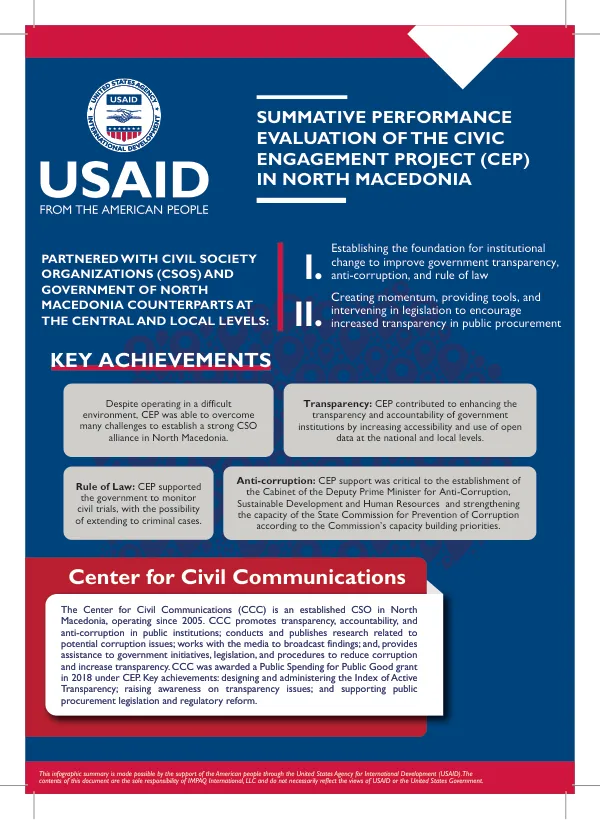
The Civic Engagement Project (CEP) in North Macedonia aimed to establish a strong alliance between civil society organizations (CSOs) and government counterparts at the central and local levels.
2021 · 2 pages
Sign in to readA free account is required to download.
Abstract
The project's primary objectives were to improve government transparency, anti-corruption, and rule of law by establishing institutional change. CEP achieved significant milestones in enhancing transparency and accountability within government institutions. The project increased accessibility and use of open data at both national and local levels, contributing to a more transparent and accountable government. Additionally, CEP supported the government in monitoring civil trials, with the possibility of extending this initiative to criminal cases. The project also focused on anti-corruption efforts, providing critical support to the establishment of the Cabinet of the Deputy Prime Minister for Anti-Corruption, Sustainable Development, and Human Resources. Furthermore, CEP strengthened the capacity of the State Commission for Prevention of Corruption, aligning with the Commission's capacity-building priorities. The Center for Civil Communications (CCC), a prominent CSO in North Macedonia, played a crucial role in the project. CCC, established in 2005, promotes transparency, accountability, and anti-corruption in public institutions. The organization conducted research on potential corruption issues, worked with the media to disseminate findings, and provided assistance to government initiatives aimed at reducing corruption and increasing transparency. CCC's key achievements under CEP included designing and administering the Index of Active Transparency, raising awareness on transparency issues, and supporting public procurement legislation and regulatory reform. The project's success was made possible through a Public Spending for Public Good grant awarded to CCC in 2018. Recommendations for future initiatives include strengthening public and independent institutions with roles related to transparency, anti-corruption, and rule of law. This involves explicitly defining the roles and rules of engagement for each stakeholder. Additionally, the focus should be on outcome and impact indicators, targets, and results, with clear expectations for changes in consultation with the government and targeted public or independent institutions. Strategic selection of key interventions for systemic change is also essential, given the multiple layers within each area of transparency, anti-corruption, and rule of law. Long-term technical assistance from independent and neutral experts is recommended to facilitate and monitor the implementation of USAID-funded institutional support. Furthermore, comprehensive and inclusive engagement of a wide range of stakeholders, particularly public institutions, is necessary for successful interventions. Youth and youth groups should be strengthened on transparency, anti-corruption, and rule of law issues, their leadership, and communication skills. Identifying change agents and monitoring their capacity to conduct actions or engagements with relevant CSOs and local government is also crucial.