USAID DEC
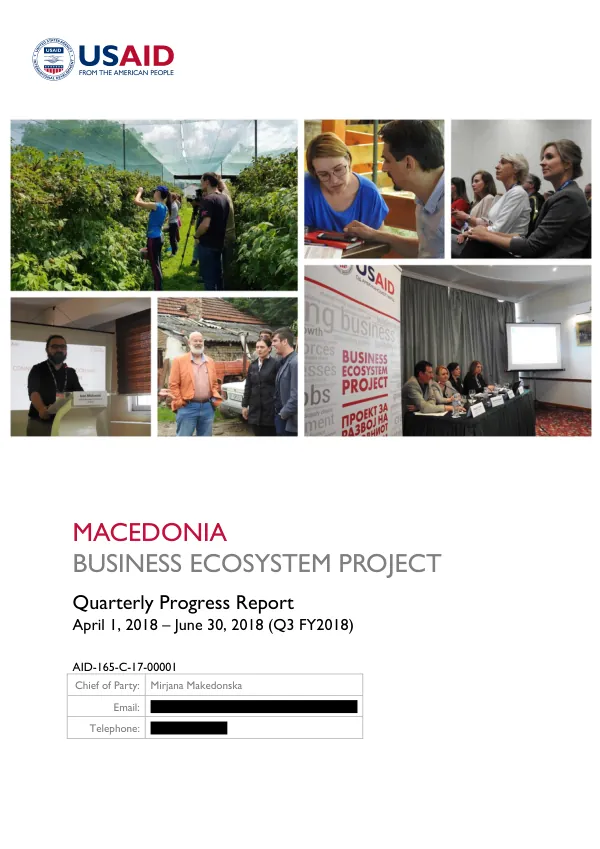
Macedonia Business Ecosystem Project Quarterly Progress Report (April 1, 2018 – June 30, 2018)
Sign inPALLADIUM INTERNATIONAL, LLC
Macedonia Business Ecosystem Project Quarterly Progress Report (April 1, 2018 – June 30, 2018)
The Business Ecosystem Project in Macedonia is a four-year economic development project that aims to transform the competitiveness of micro, small, and medium enterprises (MSMEs) in the country.
2018 · 50 pages
Sign in to readA free account is required to download.
Abstract
The project, implemented by Palladium International, officially started operating on September 29, 2017, and is set to conclude in September 2021. The project's life of project budget is currently $6.2 million. The project has three overarching and interlinked objectives: Improved Business Support Organization (BSO) Services to MSMEs, Improved MSMEs' Access to Sources of Financing, and Lead Firms Investing in the Development of Supply Chains and Labor Forces. To achieve these objectives, the project will strengthen BSOs to provide services for MSMEs and start-ups, work with traditional and alternative financial instruments to ensure appropriate sources of financing are available and accessible for business expansion efforts, and catalyze lead firms to invest backward in their supply chains. During the third quarter, the project made continual progress on all three objectives and cross-cutting activities. Under Objective 1, the project launched a process to evaluate and select BSOs that will be awarded a grant to build their capacity and upgrade their services to their MSME members. Eight BSO grantees were selected to develop new or upgrade existing business services in a wide range of sectors, including agriculture, light manufacturing, solar energy, and transportation. Under Objective 2, the project's financial facilitators continued to source and package new deals for financing, and the project added new facilitators to its numbers. The quarter finished with a total of 37 financial facilitators who successfully assisted 76 companies to access 19.6 million USD. The facilitators worked with a total of 114 companies throughout the quarter, putting the facilitators' success rate at 66.6%. With the addition of the companies' own funding (2.7 million USD), the total private sector investments made were 22.3 million USD. To help MSMEs access funds from government sources, the project organized a matchmaking event where the facilitators could familiarize themselves with the funding programs offered by government institutions. After private sector interest in FITR's programs increased, the project entered into collaboration with FITR, which resulted in the publishing of a list of facilitators on the FITR website. This further increased MSME interest in hiring facilitators and contributed towards Objective 2 goal – making consulting work marketable and self-sustaining. The project also continued with promotional activities, developing a success story that expounds on the need and value of financial facilitation while highlighting the case of Gevgelija-based Vori, a company whose financial troubles were resolved by a facilitator engaged under BEP's Objective 2. Through showcasing the value of consultants in accessing finance, the project strives to promote consulting expertise as a solution for a wide range of issues, such as cost accounting, management, etc. In addition, the project is moving forward with the whitepaper analysis of several targeted sectors. These whitepapers will inform the project's strategy in addressing sector-specific issues under all objectives. In this quarter, the project, PointPro, and MAMEI finished the second white paper for the light manufacturing sector. The first whitepaper on apparel, completed in the previous quarter, was presented at the first A2F matchmaking event organized in cooperation with the Textile Cluster. Under Objective 3, the project used its network of local organizations, consultants, mayors, and LED teams to present its Private Sector Engagement (PSE) component to over 19 companies across Macedonia. As a result, nine companies submitted PSE activity ideas in the form of Letters of Interest. As a result, the project launched a total of 4 initiatives in this quarter. Four initiatives remain in the pipeline to be evaluated and potentially launched in subsequent quarters. Significant progress was made on the implementation of the new PSE initiatives, including the Team2Win engineering competition under the Rade Koncar TEP initiative, which finished successfully and the students are working on finalizing their designs ahead of schedule.