USAID DEC
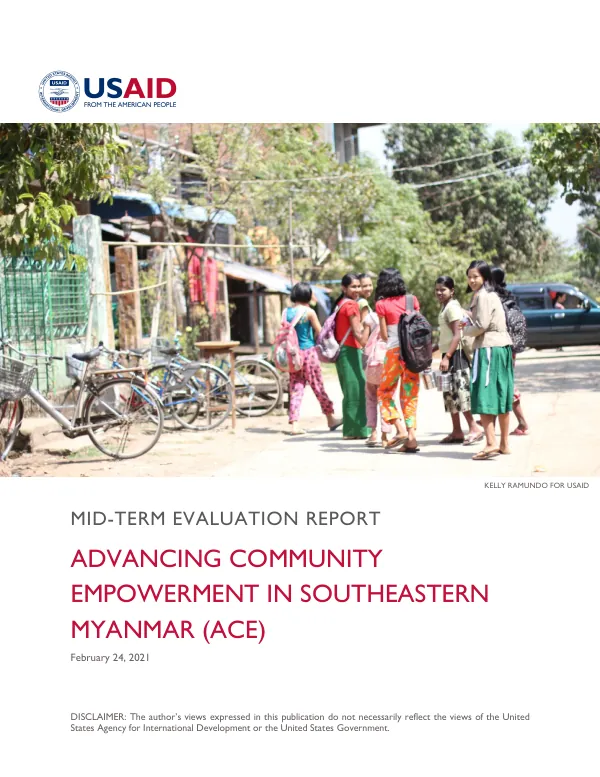
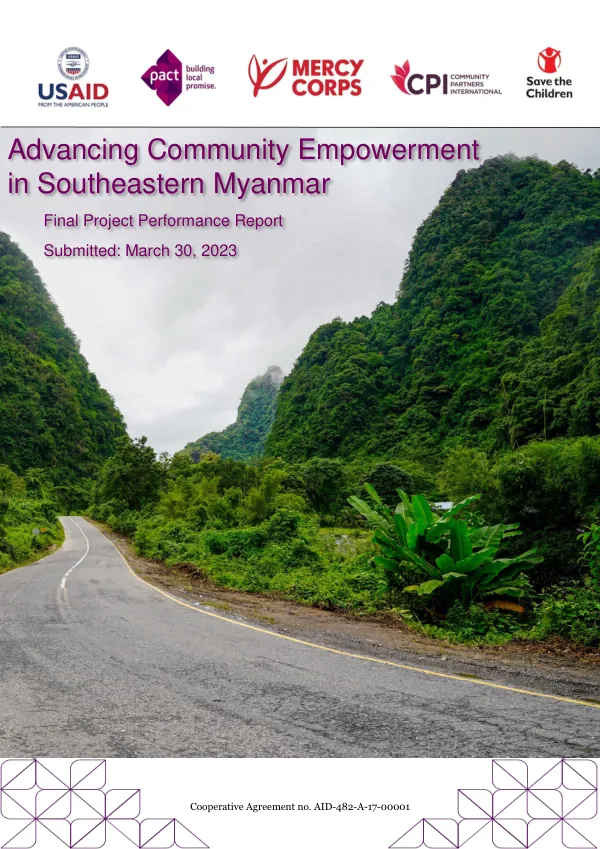
Final Project Performance Report: Advancing Community Empowerment in Southeastern Myanmar
Sign inMERCY CORPS INTERNATIONAL
Final Project Performance Report: Advancing Community Empowerment in Southeastern Myanmar
Advancing Community Empowerment in Southeastern Myanmar began in 2018 with funding from USAID's Advancing Community Empowerment in Southeastern Myanmar project.
2023 · 52 pages
Sign in to readA free account is required to download.
Abstract
The project's geographic area of focus spanned over 1,000 miles across seven states and regions in eastern and southern Shan State to southern Tanintharyi Region. The implementation area was vast, covering more than 3,700 locations, where one million people, many of them among the most vulnerable, received support from the project. The project's objective was to reduce community vulnerabilities and strengthen community participation, local governance systems, and disaster risk management. To achieve this, the project implemented five Intended Results (IRs) under Objective I: Community Vulnerabilities Reduced. IR I.1 aimed to improve healthcare access and coordinated service delivery, while IR I.2 focused on education access and services. IR I.3 promoted sustainable livelihoods, IR I.4 improved water, sanitation, and hygiene (WASH), and IR I.5 increased community capacity for preparedness, mitigation, and response to disasters. Under Objective II: Community Participation Strengthened, the project implemented five IRs, including community capacity and leadership skills improvement, participatory community decision-making capacity improvement, and community action plan development. The project also aimed to enhance trust and reconciliation, increase youth and women's participation, and strengthen local governance systems. To achieve these objectives, the project implemented various activities, including community-based education, community health systems strengthening, and disaster risk management. The project's implementation focused on developing constructive partnerships with 400 villages across the region, providing assistance for a variety of priorities identified by the communities themselves. The project staff, including community trainers, spent many hours helping build inclusive community leadership, often traveling to remote areas along hilly and muddy roads by motorbike. The project incorporated an adaptive management approach to remain nimble considering changes in the operating environment and responsive to communities' changing needs. The project's impact was significant, with over one million people receiving support across more than 3,700 locations. The project's staff and international partners, including Save the Children, Mercy Corps, and Community Partners International, worked together to provide integrated service provision for health, education, livelihoods, local governance, and disaster risk management in many marginalized communities in the southeast. The project's dedication and flexibility shined through, particularly during the COVID-19 pandemic, when the project worked through community governance structures to aid with pandemic response, hygiene and sanitation, access to finance, livelihoods, and nutrition. The project's management challenges and adaptations were significant, particularly during the COVID-19 pandemic. However, the project's staff and international partners worked together to address these challenges and ensure the project's continued success. The project's lessons learned and recommendations for future programming highlighted the importance of community-led development, adaptive management, and integrated service provision. The project's success demonstrated the potential for community empowerment and development in Southeastern Myanmar, and its impact will continue to be felt in the region for years to come.
Related documents