USAID DEC
Final Report: AgBiz Project for Agrolozar/Dalvina in Macedonia
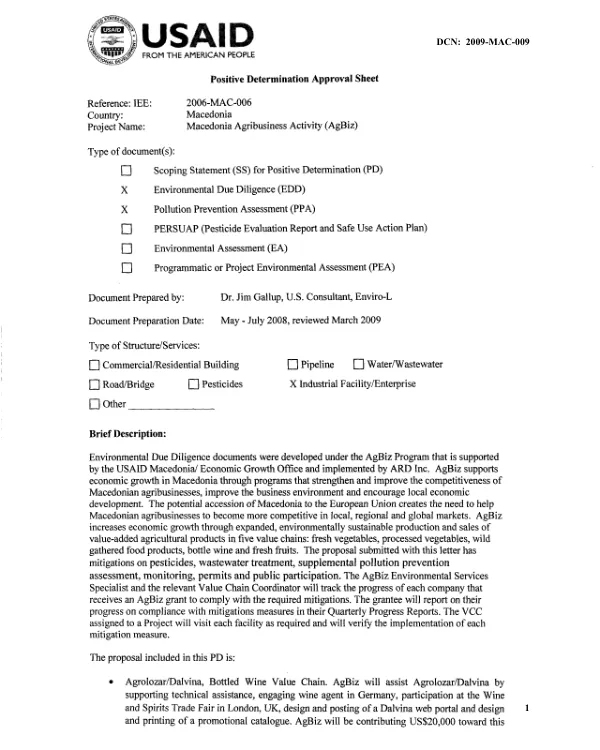
The proposed project, valued at US$361,000, aims to enhance the visibility and competitiveness of Dalvina's wine in export markets.
2009 · 26 pages
Sign in to readA free account is required to download.
Abstract
Agrolozar, a common stock company, is the primary beneficiary of the project. The company is located in Hamsali Village, Strumica, Macedonia, and operates on 840 hectares of land. Agrolozar produces grapes and other agricultural products, with a focus on wine production. The company's wine production process involves several stages, including unloading grapes, crushing, pressing, fermentation, and stabilization. Wastewater is generated during the process, primarily from cleaning the grape crusher and press, as well as from cleaning the fermenters and stabilization tanks. The wastewater will be discharged into a new wastewater treatment system. Agrolozar uses pesticides on their vineyards and other agricultural areas, and must provide annual pesticide training to ensure proper handling and use. A Pesticide Evaluation Report and Safe Use Action Plan (PERSUAP) has been conducted by AgBiz, and the results will be used to develop a comprehensive pesticide use plan. The project involves several mitigation and monitoring recommendations, including pesticide management, wastewater treatment, monitoring, permits, and public participation. A supplemental Pollution Prevention Assessment (PPA) will be conducted at the winery during the grape crushing season to identify opportunities to reduce waste and water usage. Agrolozar must also collect wastewater samples and provide analytical results, and receive necessary construction and environmental permits. The company's owner, Risto Gligorov, is the president of the management board, and can be contacted at 070 204 896 or [email protected]. The project is expected to enhance the competitiveness of Dalvina's wine in export markets, and contribute to the economic growth of Macedonia. Agrolozar's wine production process involves the use of state-of-the-art equipment, including an Italian origin wine press that produces wine according to the gravitational method, "De Fancescshi." The company's wine cellar is built on a 4,000 square meter site, and is designed to meet all required standards for food safety and quality. The winery has a capacity to produce 2.25 million liters of wine per year, with 75% of the production being red wine and 25% white wine. The company's vineyards include a variety of grape species, including Vranec, Cabernet Sauvignon, Merlot, and others. Agrolozar also produces table grapes, which are sorted and packed in carton boxes for sale in Serbia, Croatia, and Germany. The company's agricultural production includes peaches, pears, and watermelons, which are also sold in local and regional markets. The project's expected outcomes include improved competitiveness of Dalvina's wine in export markets, increased economic growth, and enhanced environmental sustainability of the company's agricultural production.