USAID
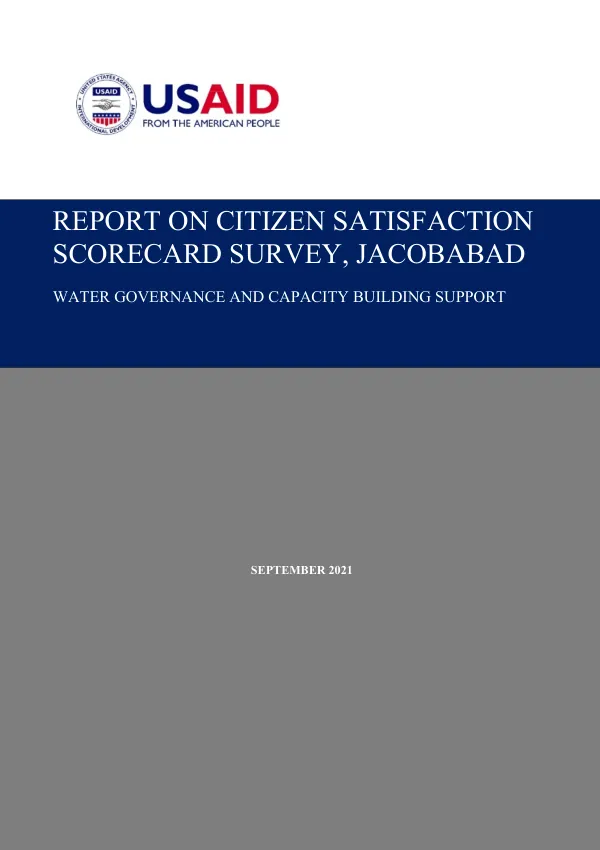
Final Report: Citizen Satisfaction Scorecard Survey, Jacobabad
The citizen satisfaction scorecard survey in Jacobabad, Pakistan, was conducted in September 2021 to assess the access, quantity, quality, and reliability of water supply, wastewater, and solid waste management services.
2021 · 86 pages
Sign in to readA free account is required to download.
Abstract
The survey was commissioned by the Health and Nutrition Development Society (HANDS) under the USAID's Water Governance and Capacity Building (WGCB) Support Activity. The survey aimed to determine the level of satisfaction among citizens regarding the water supply services, including access, quantity, quality, and reliability. The survey also assessed the wastewater and solid waste management services in Jacobabad city. The survey methodology involved a quantitative survey, which included a household questionnaire, and a qualitative survey, which consisted of in-depth interviews and focus group discussions. The survey team was trained on the data collection tools, and the data collection phase was conducted in accordance with the COVID-19 standard operating procedures. The data management process involved data security and storage, data editing, entry, and cleaning, and data analysis. The findings of the survey revealed that the respondents' profile showed a high level of education and income, with a majority of respondents being male. The survey results indicated that the access to water supply services was high, with 95% of households having access to piped water. However, the quantity of water supply was found to be inadequate, with 70% of households reporting that they did not have enough water for their needs. The quality of water supply was also found to be a concern, with 60% of households reporting that the water was not safe for drinking. The reliability of water supply services was also a concern, with 50% of households reporting that they experienced frequent water outages. The survey results also indicated that the access to wastewater services was low, with only 20% of households having access to sewerage connections. The quality of wastewater services was also found to be poor, with 80% of households reporting that the wastewater was not properly treated. The solid waste management services were also found to be inadequate, with 70% of households reporting that they did not have access to regular waste collection services. The quality of solid waste management services was also found to be poor, with 80% of households reporting that the waste was not properly disposed of. The survey concluded that the water supply services in Jacobabad city were inadequate, and the citizens were not satisfied with the services provided. The survey recommended that the government and other stakeholders should take immediate action to improve the water supply services, including increasing the quantity and quality of water supply, and improving the reliability of water supply services. The survey also recommended that the government should improve the wastewater and solid waste management services in the city.
Related documents