USAID DEC
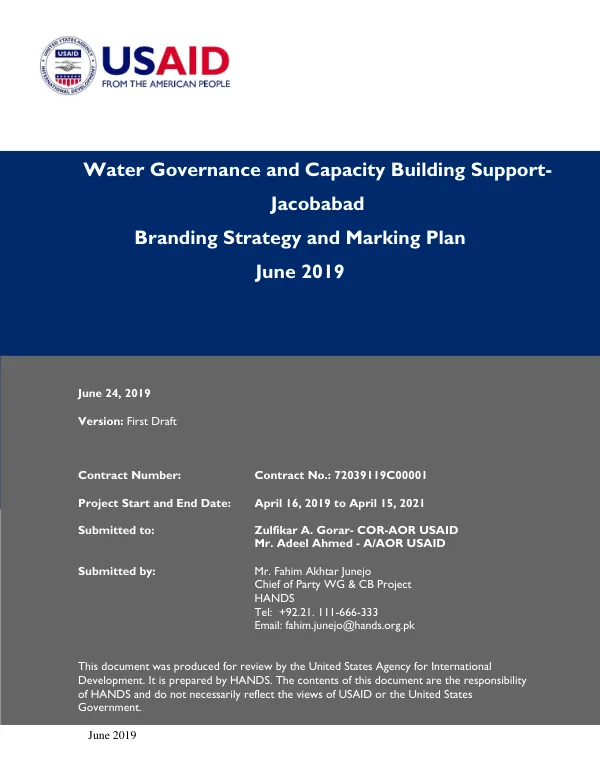
Branding Strategy and Marking Plan for Water Governance and Capacity Building Support in Jacobabad, Sindh, Pakistan
Sign inUSAID
Branding Strategy and Marking Plan for Water Governance and Capacity Building Support in Jacobabad, Sindh, Pakistan
The Water Governance and Capacity Building Support project in Jacobabad, Sindh, Pakistan, is a 24-month initiative funded by the United States Agency for International Development (USAID).
2019 · 7 pages
Sign in to readA free account is required to download.
Abstract
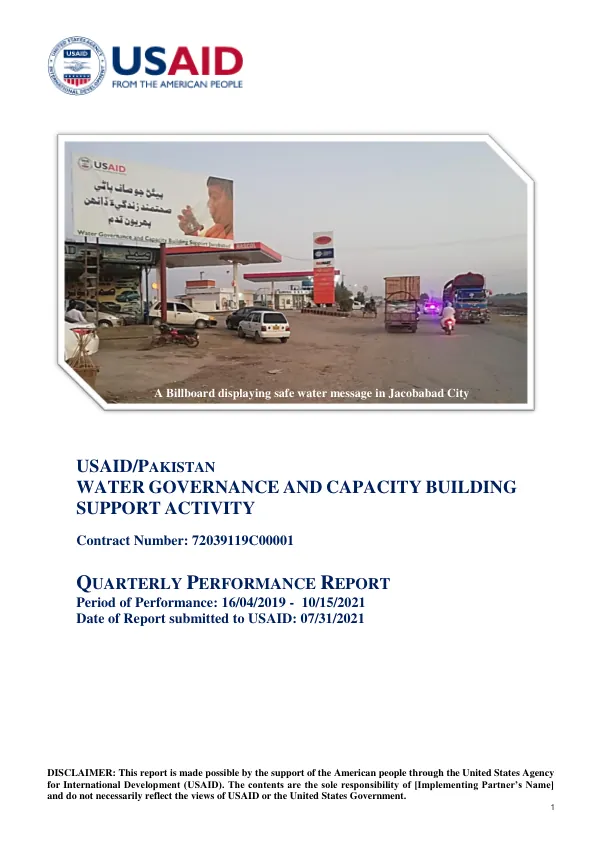
The project aims to improve water and sanitation services in Jacobabad city, with a focus on community engagement and capacity building. The project's branding strategy and marking plan emphasize the importance of positioning the project as a collaborative effort between USAID and the Municipal Committee of Jacobabad. The project title, "USAID's Water Governance and Capacity Building Support in Jacobabad, Sindh, Pakistan," reflects this partnership. In local languages, the project will be referred to as "USAID's Water Governance and Capacity Building Support in Jacobabad." The primary audience for the project is the residents of Jacobabad city, while secondary beneficiaries include municipal employees, local government officials, and community leaders. The main program message is "USAID and the Municipal Committee of Jacobabad join hands to improve the city's water and sewerage systems and support a pollution- and disease-free environment for all." To promote the project, HANDS will use a variety of communication tools, including mass media campaigns, interpersonal communication, and community mobilization. The project will also engage with policymakers, academics, and researchers to facilitate policy-making and legislation for securing water, sanitation, and hygiene as a fundamental right. Key milestones and interventions include raising public awareness through mass media campaigns, community involvement and engagement in monitoring and user fee assessment, and facilitating the development of need-based implementable strategies and policies with the Government of Sindh. HANDS will also conduct research studies on risk factors for water-borne diseases, water accounting, and public-private partnerships in water, sanitation, and hygiene. The project will document best practices and key learnings through case studies, research findings, and reports. Public communication materials will be disseminated through print and electronic media, and the project webpage will be created to share information with beneficiaries and the public. At each public event related to the project, USAID and the supporting American people will be acknowledged as key contributors to the project's success. The project's communication tools will include health and hygiene sessions, meetings with Muhalla WASH Committee members, printing of promotional materials, installation of billboards, and a project webpage on the HANDS website. Mass media campaigns will be conducted through local FM radio, cable TV, and regional newspapers to raise awareness about the project's goals and activities. Overall, the Water Governance and Capacity Building Support project in Jacobabad aims to improve water and sanitation services in the city through community engagement, capacity building, and research. The project's branding strategy and marking plan emphasize the importance of partnership and collaboration between USAID and the Municipal Committee of Jacobabad.
Related documents