USAID DEC
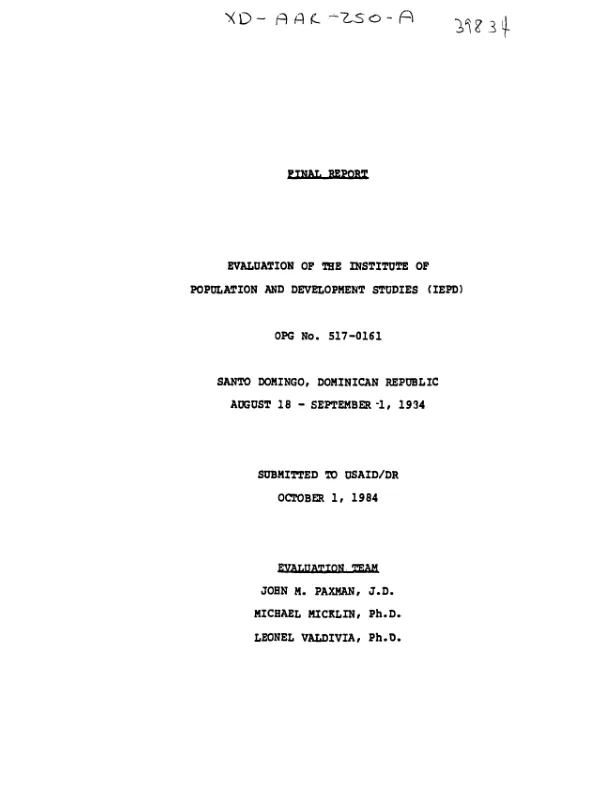
Final report : evaluation of the Institute of Population and Development Studies (IEPD)
Sign inUSAID. BUR. FOR LATIN AMERICA AND THE CARIBBEAN. OFC. OF DEVELOPMENT RESOURCES
Final report : evaluation of the Institute of Population and Development Studies (IEPD)
Evaluates project to create an Institute for Population and Development Studies (IEPD) in the Dominican Republic, under the auspices of the Dominican Family Welfare Association (PROFAMILIA).
Paxman, John M.; Micklin, Michael +1 more · 1984
Sign in to readA free account is required to download.
Abstract
Special evaluation covers the period 3/82-9/84 and is based on document review and interviews with IEPD and PROFAMILIA staff and other knowledgeable persons. Despite a design which was both overambitious and lacking in necessary implementation detail, the project successfully identified - and has filled - a serious lack in the Dominican Republic"s population planning and policymaking process. The IEPD is viewed with respect, and its advice on population and development issues is sought. To date, IEPD has produced and published three sector analyses (on labor, nutrition, and housing), five issues of a bulletin, 200 news items, and two slide-tape presentations. Training has included a seminar for journalists and another for leaders of the main opposition party. IEPD"s relationships with other organizations are excellent, resulting in a high level of active collaboration; its relationship with PROFAMILIA has proven mutually beneficial and both organizations have demonstrated flexibility in reprogramming project resources in response to particular problems. Although IEPD research is among the best in Latin America, it has sometimes rested on inadequate or outdated data and has been weak on socioeconomic (as opposed to demographic) analysis. Dissemination activities have reached a large audience, but due partly to personnel and funding constraints have lacked a cohesive strategy. While IEPD has been systematic in reaching government officials and journalists, contact with other target audiences has been sporadic and there has been little effort to tailor messages to specific audiences. IEPD is taking steps to remedy its deficiences in both research and dissemination. Hopes for the IEPD to become self-supporting are simply a pipe dream, especially in light of the Dominican Republic"s current economic crisis. Serious fundraising should be undertaken immediately to support future activities and to prevent loss of what has already been accomplished. Recommendations address staffing, communication, and funding needs.
![Project assistance competition [i.e. completion] report OPG # 517-0161-profamilia](https://covers.devme.ai/gen/8762.webp)