USAID DEC
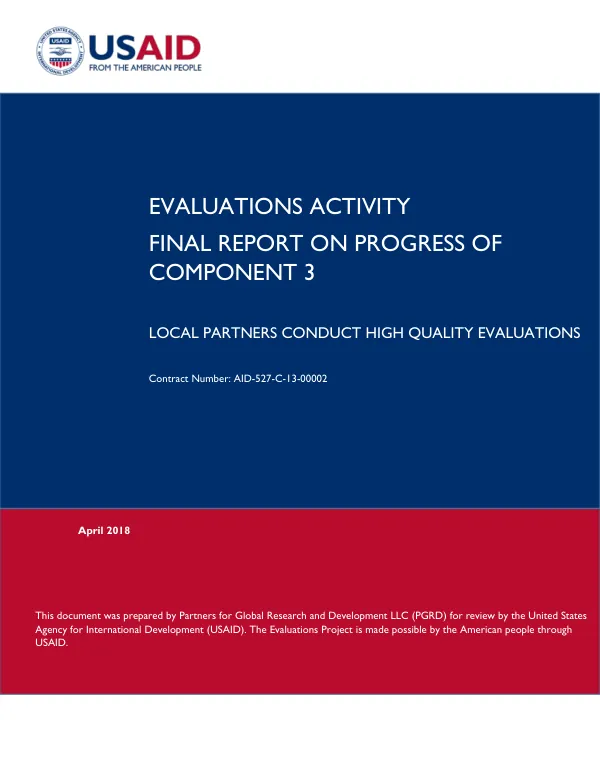
Final Report: Evaluations Activity - Component 3 - Local Partners Conduct High Quality Evaluations
Sign inUSAID
Final Report: Evaluations Activity - Component 3 - Local Partners Conduct High Quality Evaluations
The USAID/Peru Evaluations Activity was implemented from April 2013 to March 2018 to provide monitoring and evaluation (M&E) services and assistance to USAID/Peru.
2018 · 32 pages
Sign in to readA free account is required to download.
Abstract
The ultimate goal of the activity was to promote evidence-based programming through the implementation of studies and evaluations, as well as strengthen the M&E capacities of local partners. The main objectives of the Evaluations Activity corresponded to three components: design and implement impact and performance evaluation studies, provide performance monitoring and evaluation technical assistance, and strengthen the capacity of local evaluation institutions. To strengthen local evaluation institutions, the Evaluations Activity established formal agreements with two local evaluation networks: EvalPeru and PERUME. These networks were composed of evaluation consultants and employees from M&E units of various institutions, respectively. The Evaluations Activity designed and implemented a plan to strengthen the networks' capacities, based on the USAID Human and Institutional Capacity Development (HICD) approach. Technical assistance was provided for the institutional development of both networks, and 21 members participated in selecting courses for the M&E Post-graduate Diploma. The results of the Evaluations Activity showed an improvement in the performance of both networks. EvalPeru's performance improved from an average of 43% to 72%, and PERUME's performance improved from 38% to 61%. EvalPeru established standards and provided continuous capacity building to its members, while PERUME improved its communications and dissemination of evaluation results, methodologies, and practices. Both networks were important allies in disseminating M&E capacity building tools throughout the international evaluation community. The Evaluations Activity also identified the need to standardize key technical and administrative capacities of local evaluators. A 'learning-by-doing' approach was used to strengthen the capacity of subcontracted evaluation teams to implement evaluations. This approach addressed the need for evaluation products that responded to the rigor demanded under the USAID Evaluation policy, as well as the push to ensure products were optimally useful to and used by their intended audiences. Ad-hoc induction sessions and tools were prepared to guide evaluation teams about their role in the evaluation for an efficient and effective job. Participant evaluators recognized the contribution of Evaluation tools and guidance to improve the quality of evaluations conducted. The Evaluations Activity was performed in accordance with the USAID Evaluation Policy, which was released in January 2011 and updated in October 2016. The policy aimed to improve accountability, learning, and evidence-based decision-making by requiring increased rigor, objectivity, and transparency in all of USAID's evaluations. The Evaluations Activity was a key component of USAID/Peru's efforts to implement the Evaluation Policy and promote evidence-based programming. The Evaluations Activity was implemented from April 2013 to March 2018, and its main objectives were to design and implement impact and performance evaluation studies, provide performance monitoring and evaluation technical assistance, and strengthen the capacity of local evaluation institutions. The activity was performed in accordance with the USAID Evaluation Policy, which aimed to improve accountability, learning, and evidence-based decision-making. The Evaluations Activity was a key component of USAID/Peru's efforts to implement the Evaluation Policy and promote evidence-based programming.