ROBERT NATHAN ASSOCIATES
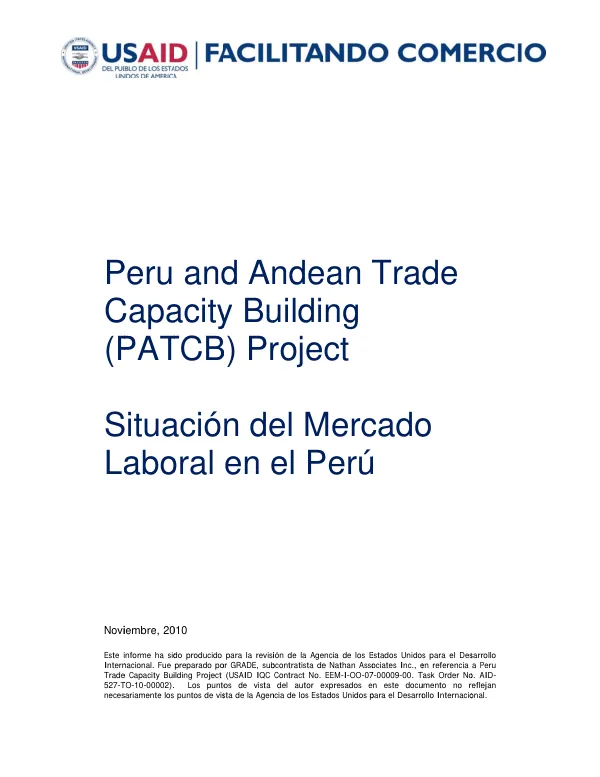
Final Report: Facilitando Comercio Project in Peru
The Peruvian labor market has undergone significant changes between 1997 and 2009.
2010 · 36 pages
Sign in to readA free account is required to download.
Abstract
The country has transitioned from a high-fertility and high-mortality regime to a low-fertility and low-mortality regime. The total fertility rate has decreased from 6 children per woman in the 1970s to 2.6 children per woman in 2009. The labor force participation rate has increased from 67% in 1997 to 72% in 2009. The participation rate of women has increased from 51% in 1997 to 57% in 2009, while the participation rate of men has decreased from 83% in 1997 to 79% in 2009. The participation rate of women has been more sensitive to the business cycle, with a decrease of 4.2 percentage points during the crisis and an increase of 8.7 percentage points during the expansion. The labor force participation rate has also been affected by the level of education. The participation rate of individuals with a higher level of education has increased, while the participation rate of individuals with a lower level of education has decreased. The participation rate of individuals with a higher level of education has been more sensitive to the business cycle, with a decrease of 5.5 percentage points during the crisis and an increase of 10.3 percentage points during the expansion. The labor force participation rate has also been affected by the area of residence. The participation rate of individuals living in urban areas has been more sensitive to the business cycle, with a decrease of 4.4 percentage points during the crisis and an increase of 7.5 percentage points during the expansion. The participation rate of individuals living in rural areas has been less sensitive to the business cycle, with a decrease of 0.1 percentage points during the crisis and an increase of 6% during the expansion. The Peruvian labor market has also experienced changes in the structure of employment. The share of formal employment has increased, while the share of informal employment has decreased. The share of formal employment has been more sensitive to the business cycle, with an increase of 10.3 percentage points during the expansion and a decrease of 5.5 percentage points during the crisis. The Peruvian labor market has also experienced changes in the level of unemployment. The unemployment rate has decreased from 8.2% in 1997 to 6.2% in 2009. The unemployment rate has been more sensitive to the business cycle, with an increase of 2.5 percentage points during the crisis and a decrease of 2.5 percentage points during the expansion. The Peruvian labor market has also experienced changes in the level of underemployment. The underemployment rate has decreased from 21.1% in 1997 to 15.6% in 2009. The underemployment rate has been more sensitive to the business cycle, with an increase of 3.5 percentage points during the crisis and a decrease of 3.5 percentage points during the expansion. The Peruvian labor market has also experienced changes in the level of poverty. The poverty rate has decreased from 53.7% in 1997 to 34.6% in 2009. The poverty rate has been more sensitive to the business cycle, with an increase of 10.3 percentage points during the crisis and a decrease of 10.3 percentage points during the expansion. The Peruvian labor market has also experienced changes in the level of inequality. The Gini coefficient has decreased from 0.55 in 1997 to 0.47 in 2009. The Gini coefficient has been more sensitive to the business cycle, with an increase of 0.02 during the crisis and a decrease of 0.02 during the expansion. The Peruvian labor market has also experienced changes in the level of informality. The informality rate has decreased from 63.1% in 1997 to 55.6% in 2009. The informality rate has been more sensitive to the business cycle, with an increase of 7.5 percentage points during the crisis and a decrease of 7.5 percentage points during the expansion. The Peruvian labor