USAID DEC
Final Report: GHG Emissions of Pasture Intensification to Meet Mato Grosso’s COP21 PCI 2030 Targets
Sign inTHE WORLD RESOURCES INSTITUTE
Final Report: GHG Emissions of Pasture Intensification to Meet Mato Grosso’s COP21 PCI 2030 Targets
Mato Grosso, a state in Brazil, is a significant contributor to the country's agricultural output.
2016 · 4 pages
Sign in to readA free account is required to download.
Abstract
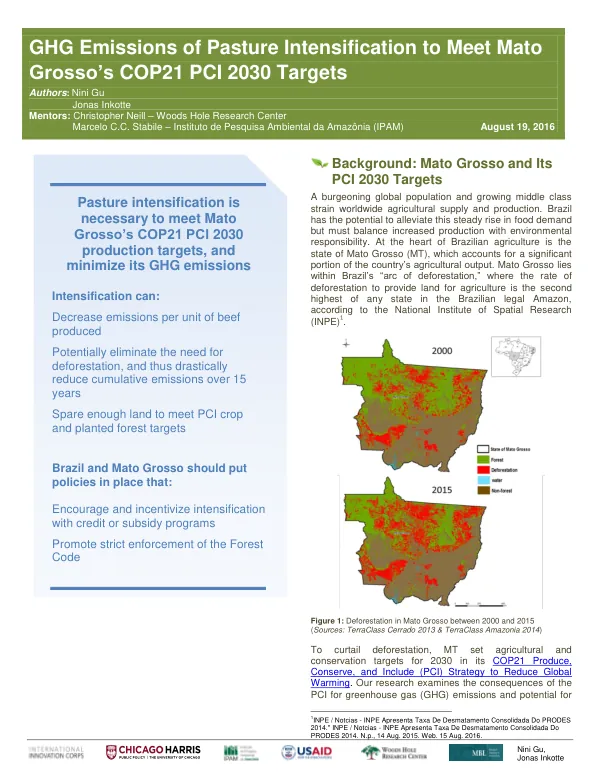
The state lies within the "arc of deforestation," where the rate of deforestation to provide land for agriculture is the second highest of any state in the Brazilian legal Amazon. To address this issue, Mato Grosso set agricultural and conservation targets for 2030 in its COP21 Produce, Conserve, and Include (PCI) Strategy to Reduce Global Warming. The PCI targets include increasing annual beef productivity to 95 kg/ha, sparing 3.5 million hectares of pasture for crops and planted forest, and increasing crop production to 92 million tonnes. To meet these production targets, pathways include creating more land for agriculture from existing forest or intensifying the use of existing agricultural land. However, maintaining current methods of pasture agriculture will not meet the productivity targets and will require further deforestation of MT's native vegetation areas. Research conducted by Nini Gu and Jonas Inkotte shows that with proper intensification of pasture areas, Mato Grosso can meet and even exceed PCI agricultural targets without further deforestation. This means a reduction in overall greenhouse gas (GHG) emissions, as well as GHG emissions per unit of production. The study used the GHG Protocol Tool to obtain GHG emissions for different pasture and cattle management levels. The GHG Protocol Tool was developed by the World Resources Institute (WRI), the World Business Council for Sustainable Development (WBCSD), and leaders in industry and environmental groups. The tool was used to calculate overall GHG emissions under three pasture intensification scenarios designed to meet the PCI 2030 beef production goal. The scenarios included intensifying exactly the area of Level 1 pastures to Level 2, intensifying exactly the area of Level 1 pastures to Level 3, and maintaining current pastures at Level 1. The results of the study show that intensification leads to decreased emissions per unit of beef produced. GHG emissions per kilogram of beef decrease as pasture is intensified from Level 1 to Level 2 to Level 3. This is a consequence of improvements in pasture quality, which allow cattle to reach their desired weight in less time. In contrast, as intensification increases the density of cattle per hectare, emissions per unit area increase. However, because the increase in production is greater than the increase in GHG's with intensification, converting areas of current Level 1 pastures to other levels allows lower GHG production overall per unit of beef produced and potentially frees some current Level 1 pasture for other uses. The study also shows that no intensification results in significantly higher cumulative emissions, mostly from deforestation. The differences in cumulative emissions directly from different levels of pasture management were relatively small. However, disproportionately large emissions from the scenario that did not intensify pastures occurred because of the additional area of forest clearing required. The cumulative GHG's emitted by 2030 will be 4,698 Mt of CO2e under the scenario that did not intensify pastures; 608 Mt of CO2e under the scenario that intensified pastures to Level 2; and 584 Mt of CO2e under the scenario that intensified pastures to Level 3.
Related documents