ABT ASSOCIATES
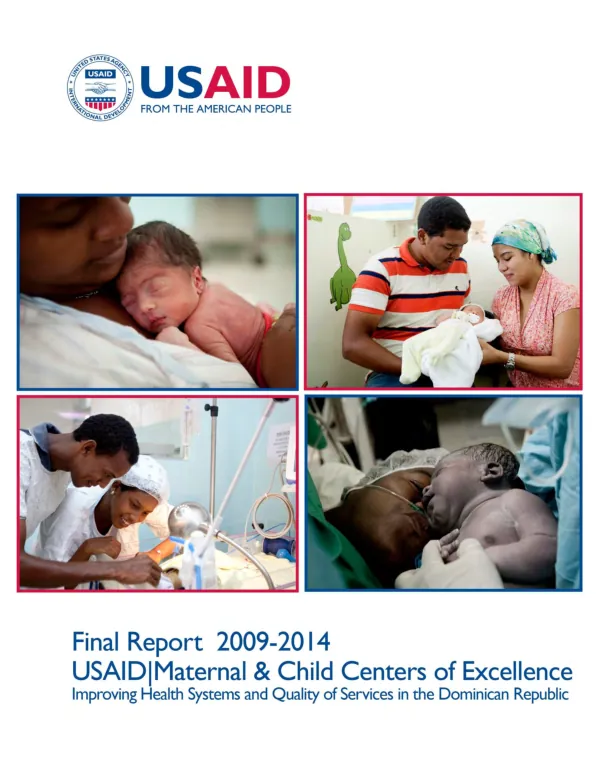
Final Report: Maternal & Child Centers of Excellence Project 2009-2014
The Maternal & Child Centers of Excellence project was funded by the United States Agency for International Development and implemented by Abt Associates Inc.
2014 · 66 pages
Sign in to readA free account is required to download.
Abstract
in collaboration with SISPROSA, INTEC, CESDEM, CES, and Cultural Practice, LLC. The project aimed to improve maternal and child health outcomes in the Dominican Republic. The project's results framework, as depicted in Figure 1, outlined four main results: development of centers of excellence in hospitals, development of centers of excellence in provincial health directorates, support to regional health services, and consolidation of interventions in Region V. The project's methodology involved a preparation phase, implementation phase, consolidation phase, and replication phase. The centers of excellence model, as outlined in the implementation plan, focused on preparing hospitals to provide high-quality maternal and child health services. This involved training hospital staff, improving infrastructure, and enhancing management capacity. The project also established a certification system to encourage quality processes, with main achievements including the development of a certification framework and the initial certification of several hospitals. Progress towards certification as a center of excellence was made in several hospitals, with scores on certification as CoEx assessments showing significant improvement from baseline to final evaluation. The project also supported the development of centers of excellence in provincial health directorates, with main achievements including the establishment of a provincial health directorate in Region V and the development of a provincial health plan. The project's support to regional health services involved providing technical assistance and training to regional health staff. This included the development of a regional health plan and the establishment of a regional health information system. The project also consolidated interventions in Region V, with main achievements including the establishment of a regional health directorate and the development of a regional health plan. Cross-cutting results included the dissemination and sharing of best practices, with main achievements including the development of a best practice guide and the conduct of best practice dissemination activities. The project also responded to the 2010 earthquake in Haiti, with main achievements including the provision of emergency obstetric care and the establishment of a temporary health facility. Outcomes of the project included a significant reduction in maternal deaths in target hospitals, with evolution of maternal deaths showing a decline from 2009 to 2013. The project also improved management capacity in participating hospitals, with the management capacity index showing significant improvement from 2010 to 2013. Tracer indicators in the ten hospitals supported by the project also showed significant improvement from 2009 to 2013. Lessons learned from the project included the importance of strong collaboration and partnership between stakeholders, as well as the need for flexible and adaptive project implementation. Recommendations for future projects included the need for continued support to regional health services and the importance of monitoring and evaluation to ensure project success.
Related documents
Documents in this collection
 2013
2013USAID DEC
PERCEPCIÓN DE LAS USUARIAS Y LOS USUARIOS SOBRE LA CALIDAD DE LOS SERVICIOS PEDIÁTRICOS Y OBSTÉTRICOS, EN HOSPITALES SELECCIONADOS DEL MINISTERIO DE SALUD PÚBLICA DE LA REPÚBLICA DOMINICANA: UN ANÁLISIS COMPARATIVO, 2010 -2013
Open record 2016
2016USAID DEC