USAID DEC
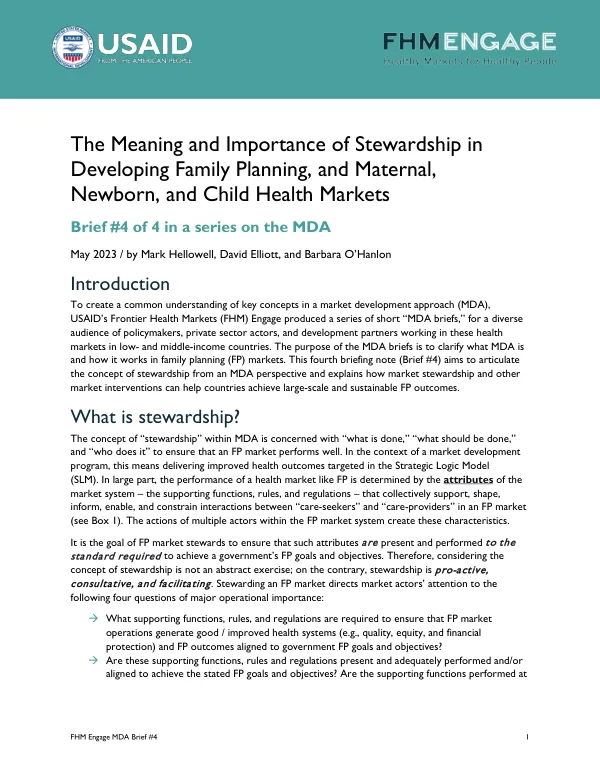
The Meaning and Importance of Stewardship in Developing Family Planning, and Maternal, Newborn, and Child Health Markets
Sign inABT ASSOCIATES
The Meaning and Importance of Stewardship in Developing Family Planning, and Maternal, Newborn, and Child Health Markets
The concept of stewardship in a market development approach (MDA) is concerned with ensuring that a family planning (FP) market performs well.
2023 · 6 pages
Sign in to readA free account is required to download.
Abstract
This involves delivering improved health outcomes targeted in the Strategic Logic Model (SLM). The performance of a health market like FP is determined by the attributes of the market system, including supporting functions, rules, and regulations that collectively support, shape, inform, enable, and constrain interactions between care-seekers and care-providers. Stewardship involves aligning the incentives, capacities, and accountability structures among diverse market actors to address the underperformance of key market functions. This includes mobilizing or consulting market actors through platforms for policy dialogue, diagnosing the FP market's core market operations and its market systems performance, and co-creating a vision of a well-performing FP market that aligns the market actors' roles, responsibilities, and actions. Government health authorities retain the ultimate responsibility to monitor and sustain progress on health and FP outcomes. However, stewardship can be performed by multiple different actors, including public market actors, private market actors, and civil society groups representing key segments of FP consumers. These actors can work together to ensure that the FP market operates in a manner that improves FP outcomes. The Ministry of Health has a unique role in the health system, making system-wide decisions, creating the means to achieve them, and mobilizing actors accordingly. However, it is not the only actor that can perform stewardship. Other actors can and do perform stewardship, and in some cases, they may have stronger incentives and capacities to do so. Stewardship involves a range of activities, including collecting, analyzing, and disseminating market intelligence about health-related products and services, strengthening and facilitating regulation of care-seekers and/or care-providers' activities, ensuring financing that supports or shapes care-seekers and/or care-providers' activities, and monitoring performance and holding market actors accountable. The concept of stewardship is not an abstract exercise; on the contrary, it is proactive, consultative, and facilitating. Stewarding an FP market directs market actors' attention to the following four questions of major operational importance: What supporting functions, rules, and regulations are required to ensure that FP market operations generate good health systems and FP outcomes aligned to government FP goals and objectives? Are these supporting functions, rules, and regulations present and adequately performed and/or aligned to achieve the stated FP goals and objectives? What changes in the supporting functions, rules, and regulations are needed to support/facilitate achieving the FP goals and objectives? How will such changes be realized in practice – and by whom? In summary, stewardship in an MDA context involves ensuring that the FP market operates in a manner that improves FP outcomes by aligning the incentives, capacities, and accountability structures among diverse market actors. This can be performed by multiple different actors, including government health authorities, public market actors, private market actors, and civil society groups representing key segments of FP consumers.