ABT. GLOBAL
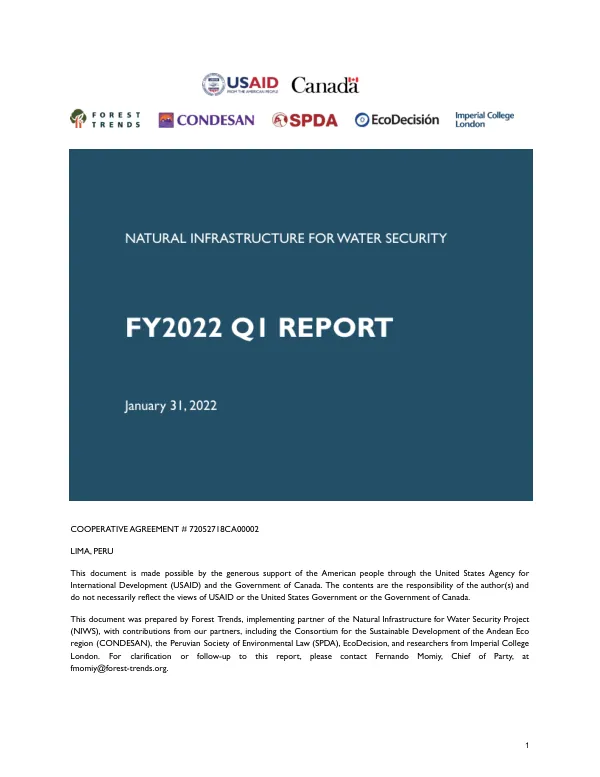
Final Report: Natural Infrastructure for Water Security in Peru
The Forest Trends' Forest Water Security Project, also known as the Natural Infrastructure for Water Security Project (NIWS), is a collaborative effort between Forest Trends, the Peruvian Society of Environmental Law (SPDA), EcoDecision, and researchers from Imperial College London, with support from the US Agency for International Development (USAID) and the Government of Canada.
2022 · 82 pages
Sign in to readA free account is required to download.
Abstract
The project aims to promote the use of natural infrastructure for water security in Peru. The project's objectives include enabling an environment for improved natural infrastructure, improving data management for decision-making on natural infrastructure, and developing portfolios of NI projects. In October and November, NIWS participated in ExpoAgua, highlighting nature-based solutions and gender equity for water. The event included speakers such as US Ambassador John McNamara, ARCC Director Amalia Moreno, and Gabriela Rosa Alanya Márquez, an alumnus of NIWS' Women's Leadership Program. The project also supported journalists and communications professionals to spread the word on natural infrastructure, resulting in over 82 articles with over 21 million views. Additionally, NIWS celebrated the adoption of Peru's new National Sanitation Plan (2022-2026), which includes reference to natural infrastructure for water security and a specific objective to enhance water supplies for human consumption. In December, NIWS contributed to the construction of the National Water Resources Policy and Strategy, formalized partnerships with watershed councils in Chira-Puira and Quilco-Chili (Arequipa), and supported the inclusion of natural infrastructure and gender equality in national and watershed-scale planning instruments. The project also saw the awarding of the National Water Culture Prize to 43 researchers, including 43% women, who will receive financial support to advance water security in Peru. NIWS also developed and improved several tools, including the HIRO rapid-focus tool, which is being further developed in partnership with MINAM to develop an improved tool for disaster risk management. The project's portfolio of natural infrastructure investments has grown to over USD 286 million, with 80% of these investments in the most mature stages of project development before mobilization. The project's geographic focus is on Peru, with a specific emphasis on the Andean region. The project's timeframes are not explicitly stated, but the document mentions progress made in FY2021 and FY2022. The project's recommendations are not explicitly stated, but the document suggests that the adoption of natural infrastructure for water security can have significant impacts on water supplies for human consumption and disaster risk management.
Related documents