ARD INC
Land Tenure & Property Rights in Colombia: USAID Program Brief
Colombia's land tenure and property rights issues have been exacerbated by decades of conflict, resulting in widespread poverty, instability, and environmental degradation.
2010 · 2 pages
Sign in to readA free account is required to download.
Abstract
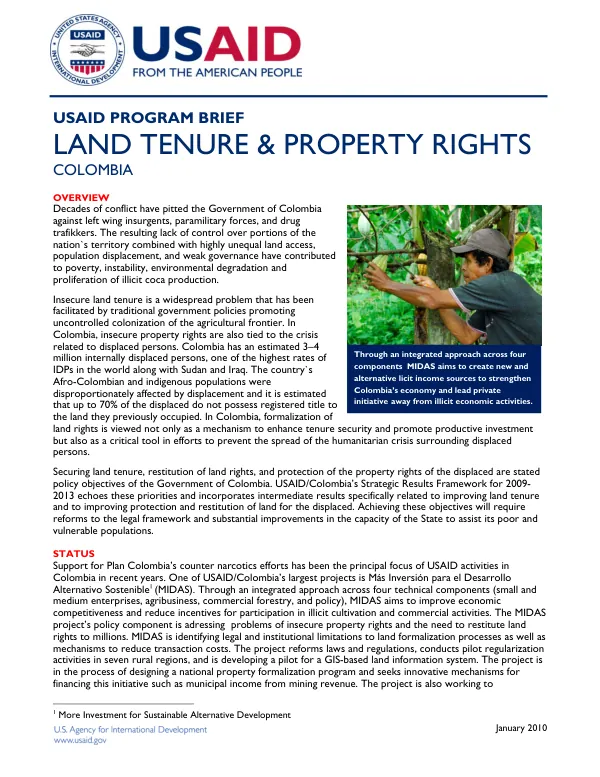
The country's lack of control over portions of its territory, combined with highly unequal land access, population displacement, and weak governance, have contributed to the proliferation of illicit coca production. Insecure land tenure is a widespread problem, facilitated by traditional government policies promoting uncontrolled colonization of the agricultural frontier. Colombia has an estimated 3-4 million internally displaced persons, one of the highest rates in the world, with the Afro-Colombian and indigenous populations disproportionately affected by displacement. It is estimated that up to 70% of the displaced do not possess registered title to the land they previously occupied. Formalization of land rights is viewed as a critical tool in efforts to prevent the spread of the humanitarian crisis surrounding displaced persons. Securing land tenure, restitution of land rights, and protection of the property rights of the displaced are stated policy objectives of the Government of Colombia. USAID/Colombia's Strategic Results Framework for 2009-2013 echoes these priorities and incorporates intermediate results specifically related to improving land tenure and to improving protection and restitution of land for the displaced. Achieving these objectives will require reforms to the legal framework and substantial improvements in the capacity of the State to assist its poor and vulnerable populations. The MIDAS project, one of USAID/Colombia's largest projects, aims to improve economic competitiveness and reduce incentives for participation in illicit cultivation and commercial activities through an integrated approach across four technical components. The MIDAS project's policy component is addressing problems of insecure property rights and the need to restitute land rights to millions. The project is identifying legal and institutional limitations to land formalization processes as well as mechanisms to reduce transaction costs. The project reforms laws and regulations, conducts pilot regularization activities in seven rural regions, and is developing a pilot for a GIS-based land information system. The project is also working to design a national property formalization program and seeks innovative mechanisms for financing this initiative such as municipal income from mining revenue. The MIDAS project has achieved several successes related to land tenure and property rights, including the signing of six international cooperation agreements to formalize rural property in 25 municipalities, benefiting over 1,500 farmers. The project has also established new judicial procedures to facilitate land restitution to displaced persons and provided technical assistance to the Ministry of Interior and Justice related to land policy for displaced persons. However, challenges remain, including the continued lack of State control over geographic areas under the domination of armed groups and/or drug traffickers, inconsistent political will to restitute and redistribute land to Colombia's poor and vulnerable, and a complex institutional environment with unclear lines of responsibility and scarce resources.
Related documents