USAID DEC
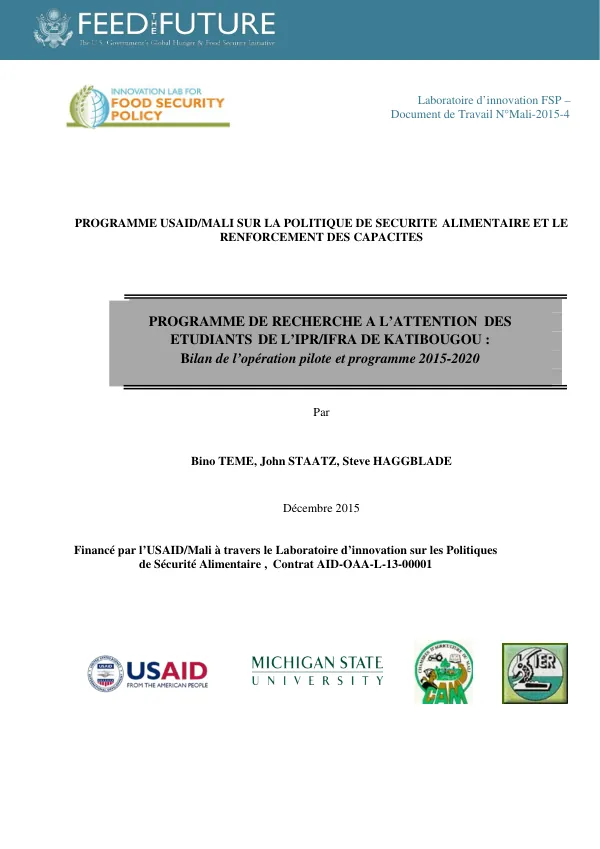
Final Report: Programme USAID/MALI Sur La Politique De Sécurité Alimentaire Et Le Renforcement Des Capacites
Sign inMICHIGAN STATE UNIVERSITY FOUNDATION
Final Report: Programme USAID/MALI Sur La Politique De Sécurité Alimentaire Et Le Renforcement Des Capacites
The agricultural development initiative in Mali, supported by the USAID/Mali program on Food Security Policy and Capacity Building, aimed to enhance the country's capacity to address food security challenges.
2015 · 53 pages
Sign in to readA free account is required to download.
Abstract
The program was implemented by the Food Security Policy (FSP) Innovation Laboratory, a consortium of Michigan State University, the International Food Policy Research Institute (IFPRI), and the University of Pretoria. The program's context and justification were rooted in the need to address the country's institutional capacity gaps, particularly in the rural development sector. A survey conducted in 2015 revealed a shortage of specialists in key technical services, including agricultural extension, research, and training. The program's objectives were to strengthen the capacity of Malian institutions, enhance the country's agricultural productivity, and improve food security. The program's pilot operation, launched in 2015, aimed to develop a framework for capacity building and identify potential partners. The pilot involved the selection of services, partners, and students for research projects. A governance mechanism was established to oversee the program's implementation, and a budget was allocated for the pilot operation. The program's research component focused on identifying research activities for students, selecting themes for their research, and providing guidance. The pilot operation's results highlighted the importance of developing a database on horticulture, which was established to support research and decision-making. The program's budget for the pilot operation was approximately $200,000. The program's proposal for a five-year implementation period (2015-2020) outlined its content, budget, and governance structure. The program's activities were prioritized, and research themes were identified, including the analysis of policy and capacity building. The program's governance structure was designed to build on the experience gained from the pilot operation. The program's budget for the five-year period was estimated at $1.5 million, with a breakdown of costs for each year. The program's conclusion emphasized the importance of strengthening Malian institutions and enhancing the country's agricultural productivity to improve food security. Key findings from the pilot operation included the identification of research themes, such as horticulture, and the establishment of a database to support research and decision-making. The program's budget was allocated to support research activities, and a governance mechanism was established to oversee the program's implementation. The program's budget for the pilot operation was approximately $200,000. The program's proposal for a five-year implementation period outlined its content, budget, and governance structure. The program's activities were prioritized, and research themes were identified, including the analysis of policy and capacity building. The program's governance structure was designed to build on the experience gained from the pilot operation. The program's budget for the five-year period was estimated at $1.5 million, with a breakdown of costs for each year. The program's conclusion emphasized the importance of strengthening Malian institutions and enhancing the country's agricultural productivity to improve food security.