USAID DEC
Quelles sont les motivations politiques pour augmenter l'offre de lait frais par les producteurs maliens
Sign inMICHIGAN STATE UNIVERSITY FOUNDATION
Quelles sont les motivations politiques pour augmenter l'offre de lait frais par les producteurs maliens
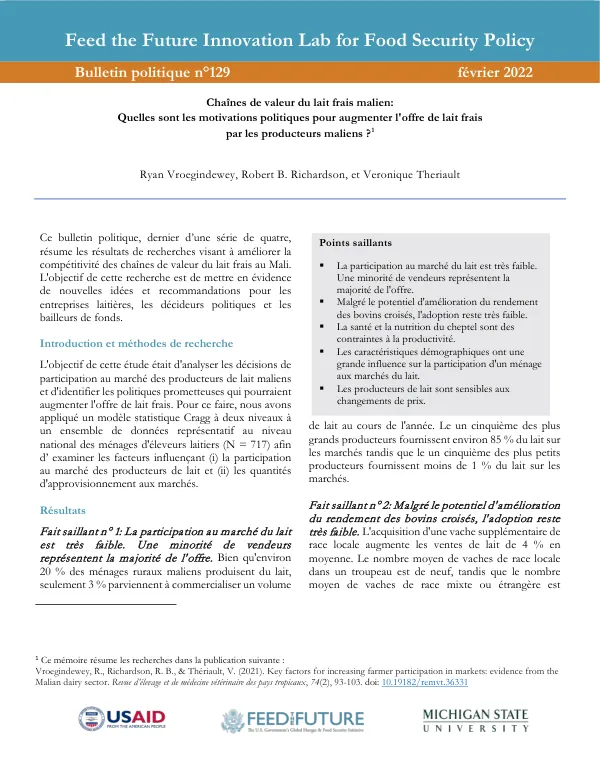
The Feed the Future Innovation Lab for Food Security Policy published a bulletin in February 2022, focusing on the dairy sector in Mali.
2022 · 3 pages
Sign in to readA free account is required to download.
Abstract
The bulletin, number 129, is the final in a series of four, summarizing research aimed at improving the competitiveness of the fresh milk value chain in Mali. The research objective was to analyze the market participation decisions of Malian dairy producers and identify promising policies to increase the supply of fresh milk. A two-level Cragg model was applied to a representative dataset of 717 households of dairy farmers to examine the factors influencing (i) market participation and (ii) quantities supplied to markets. The results highlight several key findings. Firstly, market participation in the dairy sector is very low, with a minority of sellers representing the majority of the supply. Approximately 20% of rural Malian households produce milk, but only 3% manage to commercialize a significant volume. The top 20% of producers account for around 85% of the milk sold on markets, while the bottom 20% contribute less than 1%. Secondly, despite the potential for improved productivity through crossbreeding, adoption remains very low. Acquiring an additional local breed cow increases milk sales by 4% on average. However, only 8% of households possess such a cow, and only half of these households have more than one. Thirdly, animal health and nutrition are significant constraints to productivity. Controlling ticks, accessing natural water sources during the dry season, and having a watering trough are essential factors for market participation. An increase of 1% in the treated herd, access to a natural water source during the dry season, and possession of a watering trough are each associated with increases in milk sales of 4%, 42%, and 44%, respectively. Lastly, demographic characteristics have a significant influence on market participation. Households headed by women commercialize twice as much milk as those headed by men. Peul/Peulh ethnic group households also commercialize more than other households. The implications for dairy policy and commercial strategies are fourfold. Firstly, policies should contribute to improving access to crossbred cattle. Given the concentration of milk sales in Mali, policymakers should develop adoption models for improved breeds tailored to the poorest households. Secondly, policies should promote animal health and nutrition. The government should improve its vaccination program monitoring to better understand its effectiveness and ensure that the poorest producers benefit. Policymakers can also support the development of low-cost animal feed, while encouraging agricultural operations to diversify into locally adapted forage production, such as cowpeas. Thirdly, policies should empower and dynamize female producers. Commercialization policies for milk could lead to better inclusion and autonomy of women in the dairy value chain. This could be achieved by distributing productive assets directly to women, while explicitly reinforcing their property and control rights within the household and community. Lastly, policies should strengthen access to information and price incentives. Producers are sensitive to price incentives, suggesting that macroeconomic policies have an impact on milk supply. The government could prioritize the inclusion of milk in its market information surveillance system.