USAID DEC
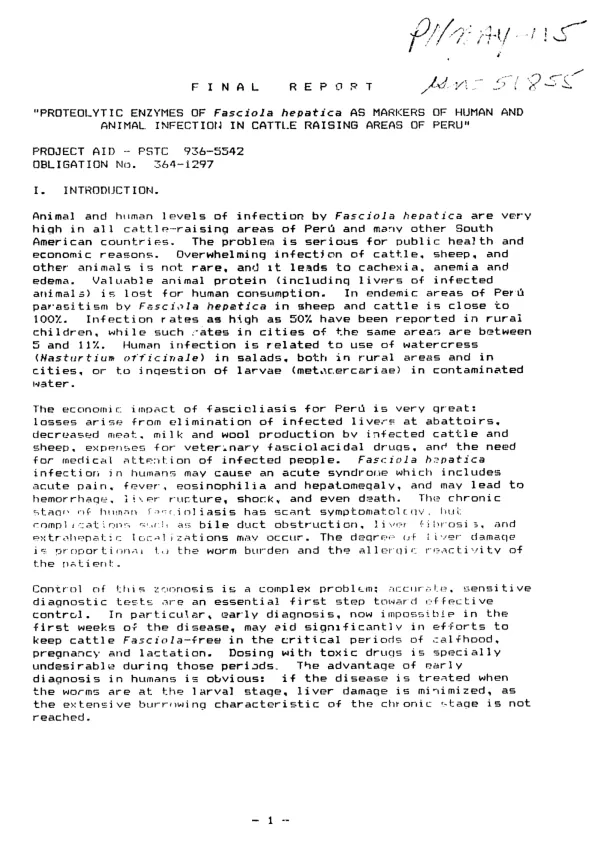
Final Report: PROTEOLYTIC ENZYMES OF Fasciola hepatica AS MARKERS OF HUMANS AND ANIMAL INFECTION IN CATTLE RAISING AREAS OF PERU
Sign inUSAID
Final Report: PROTEOLYTIC ENZYMES OF Fasciola hepatica AS MARKERS OF HUMANS AND ANIMAL INFECTION IN CATTLE RAISING AREAS OF PERU
Fasciola hepatica infection in humans may cause an acute syndrome which includes acute pain, fever, eosinophilia, and hepatomegaly, and may lead to hemorrhage, rupture, shock, and even death.
2010 · 38 pages
Sign in to readA free account is required to download.
Abstract
The chronic fascioliasis has scant symptomatology, but bile duct obstruction, liver cirrhosis, and other complications may occur. The degree of damage is directly proportional to the worm burden and the allergic activity of the patient. The overall objectives of the project were to isolate and characterize the proteolytic enzymes of Fasciola hepatica, and to study the specific antibodies to these enzymes in natural or experimental fascioliasis. The antigens obtained could be used for early diagnosis, estimation of worm load, ascertaining success of chemotherapy, and epidemiological field studies. Adult worms of Fasciola hepatica were obtained from naturally infected cattle in abattoirs in Lima, Peru. The worms were washed in 0.9% NaCl and homogenized in the same solution. Following centrifugation at 2,000 g, the separated pellet and supernatant fractions were lyophilized and studied in Lima and Baylor College of Medicine. The life cycle of the parasite was obtained through Lymnaea viatrix. Snails were brought from the Mantaro valley, one of the most important cattle-raising areas of Peru, as well as one with the highest prevalence of cattle and human infection with Fasciola hepatica. Eggs of the snails were used to begin rearing them in the laboratory. The snails were infected with miracidia of Fasciola hepatica obtained from eggs of the parasite. Proteinase assays were performed using two fluorescent substrates: CBZ-Ph'-Arg-AFC and CBZ-Arg-Arg-AFC. Assays were performed in 0.2 M citrate buffer, pH 4.9, unless otherwise stated. Thiol (5-μM) was needed to be present in the system. Azocoll assay was performed using 5 mg/ml substrate in the same buffer as above. Activity was measured at 520 nm. The specific experimental work achieved is described in the following pages. The isolation and characterization of proteolytic enzymes of Fasciola hepatica were performed using various chromatographic techniques, including ammonium sulfate precipitation, gel filtration, cationic exchange chromatography, hydrophobic interaction chromatography, and chromatofocusing.
Related documents