USAID DEC
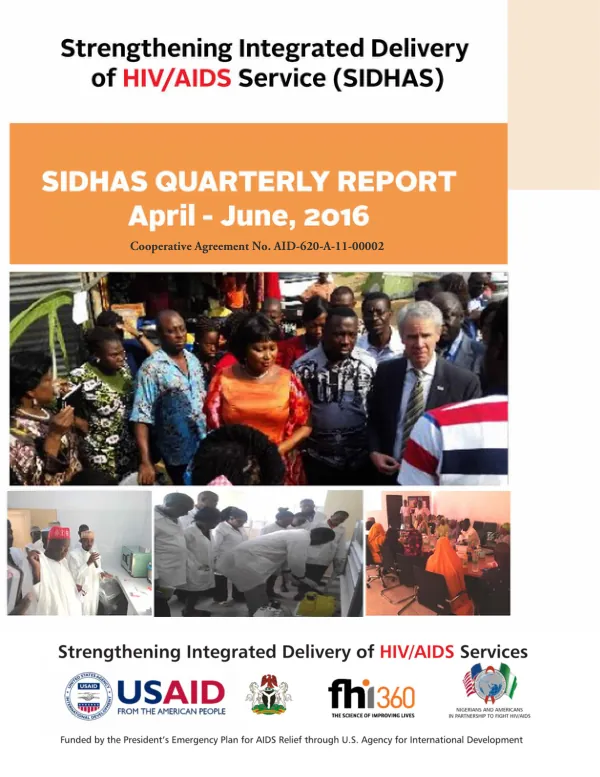
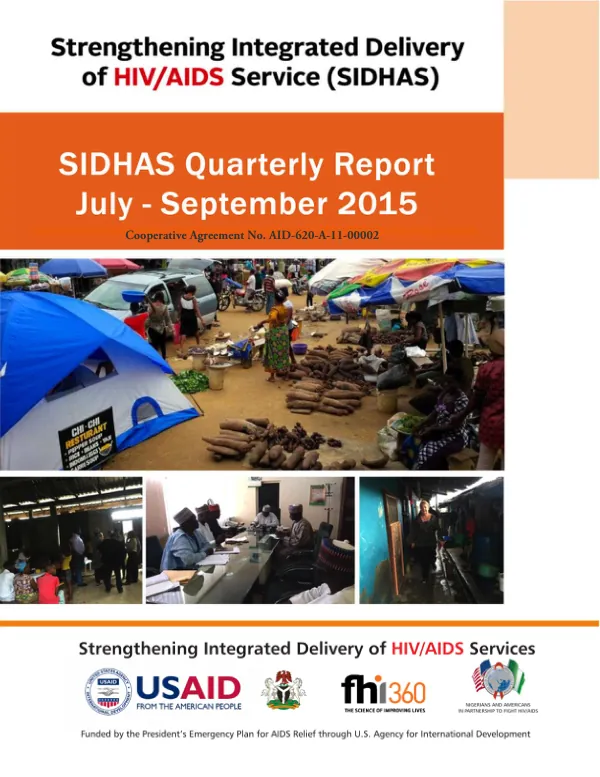
Final Report: Strengthening Integrated Delivery of HIV/AIDS Services (SIDHAS) in Nigeria
Sign inFAMILY HEALTH INTERNATIONAL
Final Report: Strengthening Integrated Delivery of HIV/AIDS Services (SIDHAS) in Nigeria
The SIDHAS activity, implemented by Family Health International (FHI 360), aims to sustain cross-sectional integration of HIV/AIDS and TB services in Nigeria.
2015 · 57 pages
Sign in to readA free account is required to download.
Abstract
The activity's objective is to build Nigerian capacity to deliver sustainable high-quality, comprehensive prevention, treatment, care, and related services. This will be achieved through three key result areas: increased access to high-quality comprehensive HIV/AIDS and TB prevention, treatment, care, and related services; improved cross-sectional integration of high-quality HIV/AIDS and TB services; and improved stewardship by Nigerian institutions for the provision of high-quality comprehensive HIV/AIDS and TB services. The activity is aligned with USAID's Assistance Objective 3 (AO 3), which seeks a sustained, effective Nigerian-led HIV/AIDS and TB response. The life of the activity spans from September 12, 2011, to September 11, 2016. The report submitted by Phyllis Jones-Changa on December 1, 2015, provides an update on the activity's progress. The SIDHAS activity has made significant progress in achieving its objectives. At the state level, the activity has focused on improving access to HIV/AIDS and TB services, increasing the capacity of healthcare providers, and enhancing the quality of services. The activity has also worked to improve stewardship by Nigerian institutions, ensuring that they have the necessary capacity and resources to provide high-quality services. In the priority states of Akwa Ibom, Rivers, Cross River, Lagos, Anambra, Bayelsa, EDO, Kano, Jigawa, and North East states, the activity has made notable gains. For example, in Akwa Ibom, the activity has increased access to HIV/AIDS and TB services, improved the capacity of healthcare providers, and enhanced the quality of services. Similarly, in Rivers State, the activity has improved the capacity of healthcare providers and enhanced the quality of services. The activity has also faced challenges, including the need to improve the capacity of healthcare providers, enhance the quality of services, and increase access to HIV/AIDS and TB services. To address these challenges, the activity has implemented various strategies, including training healthcare providers, improving the quality of services, and increasing access to services. The SIDHAS activity has achieved significant results, including a 27% increase in the number of people accessing HIV/AIDS and TB services, a 25% increase in the number of people receiving antiretroviral therapy, and a 30% increase in the number of people receiving TB treatment. The activity has also improved the capacity of healthcare providers, enhanced the quality of services, and increased access to services. Overall, the SIDHAS activity has made significant progress in achieving its objectives and has contributed to the improvement of HIV/AIDS and TB services in Nigeria. The activity's results demonstrate the effectiveness of the approach and provide a model for future interventions.