USAID DEC
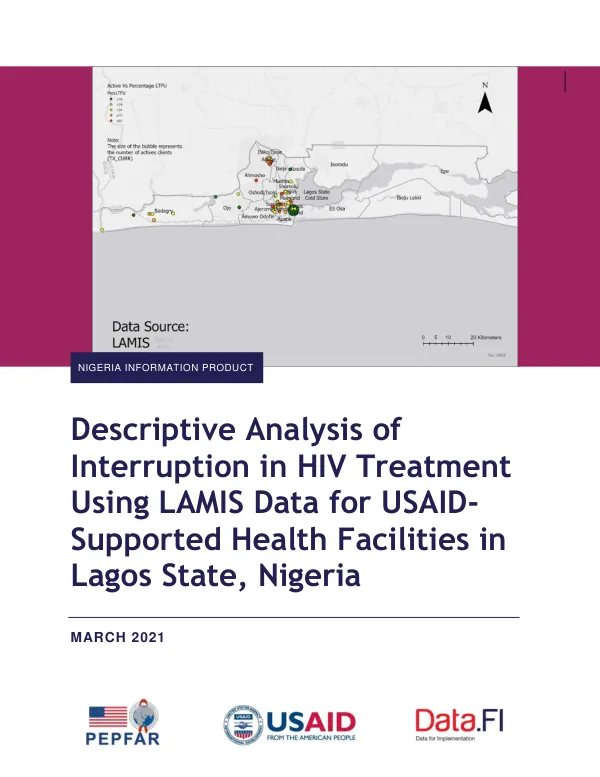
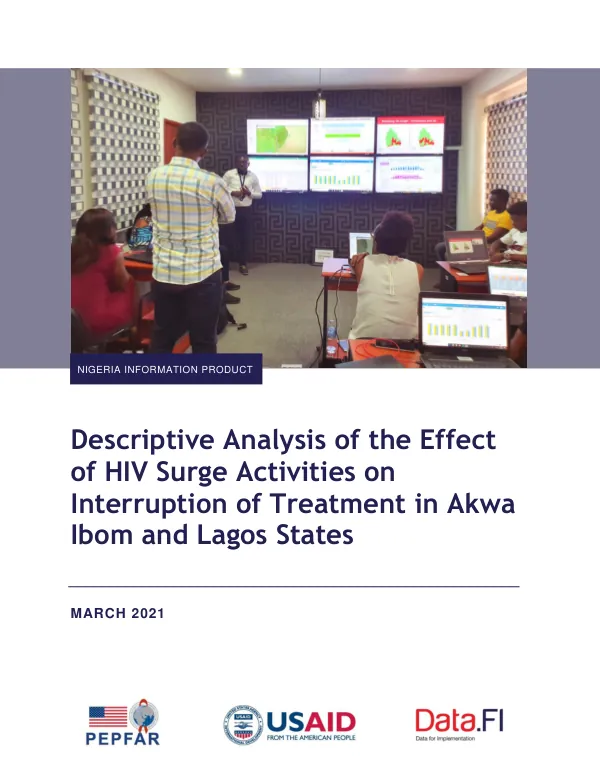
Descriptive Analysis of the Effect of HIV Surge Activities on Interruption of Treatment in Akwa Ibom and Lagos States
Sign inFHI 360
Descriptive Analysis of the Effect of HIV Surge Activities on Interruption of Treatment in Akwa Ibom and Lagos States
The HIV surge activities in Akwa Ibom and Lagos States were initiated in April 2019, following the release of preliminary results of the National HIV/AIDS Indicator Impact Survey (NAIIS).
2021 · 24 pages
Sign in to readA free account is required to download.
Abstract
The surge activities included a minimum package of "in-facility" and "community-based" interventions aimed at achieving treatment saturation for people living with HIV (PLHIV) in the two states by the end of 2020. The interventions were implemented in 220 facilities in the two states, between four USAID implementing partners: Key Population Community HIV Services Action and Response 1 (KP CARE 1); Strategic HIV/AIDS Response Program Task Order 2 (SHARP TO2); Strengthening Integrated Delivery of HIV/AIDS Services (SIDHAS); and Meeting Targets and Maintaining Epidemic Control-Reaching Impact, Saturation and Epidemic Control (TMEC-RISE). Akwa Ibom and Lagos States have large treatment gaps, with Akwa Ibom having the highest HIV prevalence rate in the country, at 5.6%, and Lagos having a 1.3% prevalence rate. The migration patterns in these states make client tracking and continuity of HIV treatment difficult. The surge activity aimed to address these challenges by providing a minimum package of interventions to support PLHIV in continuing to adhere to treatment and achieving viral suppression. The objectives of the study were to determine and quantify the effect of surge programming on initiation of clients on antiretroviral treatment (ART) and their continuity of treatment in Akwa Ibom and Lagos States. The study also aimed to compare demographics and adherence to treatment of clients before and after surge programming. The data source for the study was the Government of Nigeria/Ministry of Health (GON/MOH) system—the National Data Repository (NDR), which is supported by U.S. Agency for International Development (USAID) IPs. The study analyzed client-level line lists generated from the NDR, which included data on client demographics, ART initiation, and treatment adherence. The analysis focused on the period from March 2018 to September 2020, which included the pre-surge and surge periods. The study used descriptive statistics to summarize the data and identify trends and patterns in client engagement in treatment. The findings of the study showed that the surge activities had a significant impact on initiation of clients on ART and their continuity of treatment in Akwa Ibom and Lagos States. The study found that the proportion of clients initiating ART increased significantly during the surge period, with a higher proportion of clients initiating ART in Akwa Ibom compared to Lagos. The study also found that the proportion of clients experiencing interruption in treatment decreased significantly during the surge period, with a higher proportion of clients experiencing interruption in treatment in Lagos compared to Akwa Ibom. The study identified several factors that were associated with interruption in treatment, including age, gender, and local government area (LGA). The study found that clients in the 25-34 age group were more likely to experience interruption in treatment compared to clients in other age groups. The study also found that female clients were more likely to experience interruption in treatment compared to male clients. The study identified several LGAs in both states that had high rates of interruption in treatment, suggesting that these areas may require targeted interventions to improve client engagement in treatment. The study's findings have several implications for HIV programming in Akwa Ibom and Lagos States. The study's findings suggest that the surge activities have been effective in increasing initiation of clients on ART and reducing interruption in treatment. However, the study's findings also suggest that there are still significant challenges to be addressed, particularly in terms of client tracking and continuity of HIV treatment. The study's findings highlight the need for continued investment in HIV programming in Akwa Ibom and Lagos States, particularly in terms of providing targeted interventions to support PLHIV in continuing to adhere to treatment and achieving viral suppression. The study's findings also have implications for HIV programming more broadly. The study's findings suggest that surge activities can be an effective strategy for increasing initiation of clients on ART and reducing interruption in treatment. However, the study's findings also suggest that surge activities must be carefully designed and implemented to address the specific needs and challenges of the target population. The study's findings highlight the need for continued investment in HIV programming, particularly in terms of providing targeted interventions to support PLHIV in continuing to adhere to treatment and achieving viral suppression.