USAID DEC
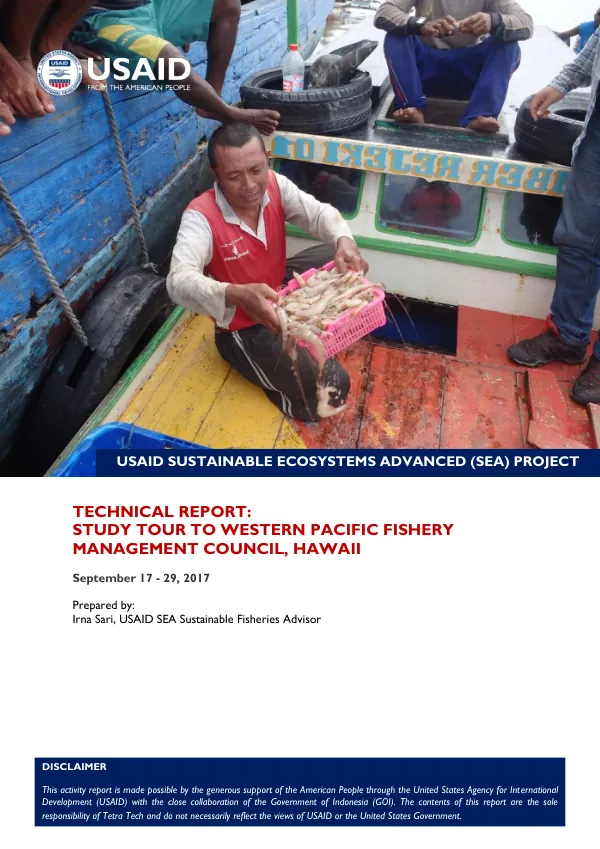
Final Report: Study Tour to Western Pacific Fishery Management Council, Hawaii. September 17-29, 2017
Sign inUSAID DEC
Final Report: Study Tour to Western Pacific Fishery Management Council, Hawaii. September 17-29, 2017
The Western Pacific Fishery Management Council is a quasi-federal agency responsible for managing fishery resources in the western Pacific region.
2017 · 27 pages
Sign in to readA free account is required to download.
Abstract
The council is composed of 11 voting members, including representatives from the state of Hawaii, American Samoa, Guam, the Northern Mariana Islands, and the Pacific Islands. The council's primary role is to develop fishery management policy recommendations based on sound science, which are then submitted to NOAA Fisheries for approval or disapproval. The council's institution structure is designed to ensure the integrity of the organization and its decision-making process. The council is funded solely by the federal government, and its staff are not classified as US government officials. This hybrid model allows the council to maintain its independence from other interests and ensure that its policy recommendations are based on sound science. The council's work mechanism involves close coordination with NOAA Fisheries, the state of Hawaii, and other stakeholders to manage fishery resources in the western Pacific region. The council's Scientific Committee plays a critical role in providing scientific contributions to inform fishery management policies. The council also works closely with NGOs and universities to empower communities and provide scientific expertise. The council's primary responsibilities include developing fishery management plans, monitoring fishery performance, and enforcing policies enacted by NOAA Fisheries. The council's fishery management plans are developed through a collaborative process involving stakeholders, including fishermen, industry representatives, and conservation groups. The plans are designed to ensure the long-term sustainability of fishery resources and to minimize the impact of fishing on the environment. The council's fishery management plans are based on sound science and are developed using a variety of tools and techniques, including stock assessments, fishery performance monitoring, and economic analysis. The plans are designed to be flexible and adaptable to changing fishery conditions and to ensure that the council's management decisions are based on the best available science. The council's work is supported by a range of stakeholders, including fishermen, industry representatives, conservation groups, and government agencies. The council works closely with these stakeholders to develop fishery management plans that balance the needs of different user groups and ensure the long-term sustainability of fishery resources. The council's fishery management plans are implemented through a range of mechanisms, including catch limits, fishing gear restrictions, and closed areas. The council also works with NOAA Fisheries to enforce policies enacted by the council and to monitor fishery performance. The council's fishery management plans have been successful in improving the sustainability of fishery resources in the western Pacific region. The plans have helped to reduce overfishing, improve fish populations, and minimize the impact of fishing on the environment. The council's work has also helped to promote the economic benefits of sustainable fishing and to support the livelihoods of fishermen and their communities. The council's experience and expertise in fishery management can provide valuable insights for the establishment of the Indonesian Fishery Management Council. The council's institution structure, work mechanism, and fishery management plans can serve as a model for the Indonesian council, and its experience in managing fishery resources can provide valuable lessons for the Indonesian government. The study tour to the Western Pacific Fishery Management Council provided a comprehensive understanding of the organizations and functions involved in fishery management in Hawaii at all levels (federal, state, and community). The tour highlighted the importance of collaboration and coordination among stakeholders to manage fishery resources effectively. The tour also provided valuable insights into the council's institution structure, work mechanism, and fishery management plans, which can serve as a model for the establishment of the Indonesian Fishery Management Council. The dissemination and adoption of the council's fishery management plans and policies are critical to ensuring the long-term sustainability of fishery resources in the western Pacific region. The council uses a range of strategies to disseminate its plans and policies, including public outreach and education, stakeholder engagement, and media outreach. The council also works closely with NOAA Fisheries and other stakeholders to ensure that its plans and policies are implemented effectively.