GOVERNMENT OF GHANA
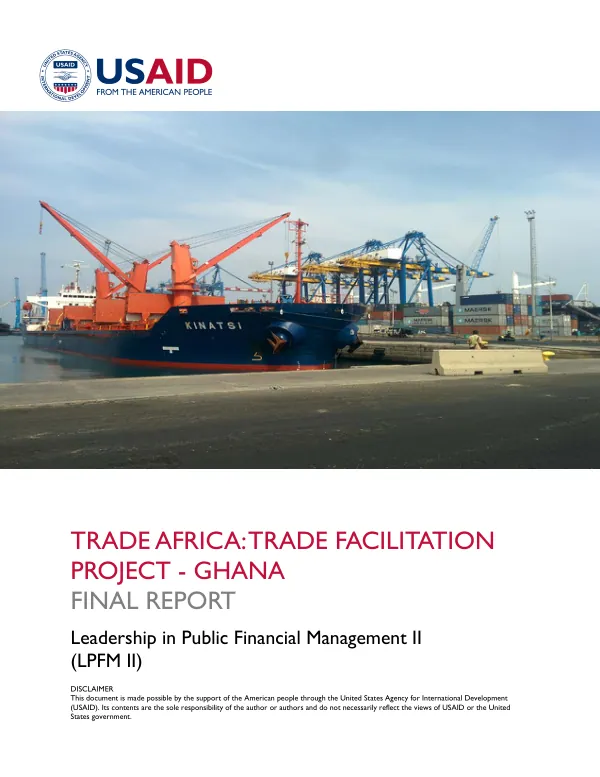
Final Report: Trade Africa: Trade Facilitation Project - Ghana
The Ghana Trade Africa: Trade Facilitation Project (TATFP) was launched in 2016 by the United States Agency for International Development (USAID) as part of the wider Trade Africa initiative.
2019 · 34 pages
Sign in to readA free account is required to download.
Abstract
The project aimed to increase internal and regional trade within Africa and expand trade and economic ties between Africa and the United States. Ghana TATFP supported the Government of Ghana (GoG) in implementing its commitments under the World Trade Organization's (WTO) Trade Facilitation Agreement (TFA). The project addressed four key TFA articles: Article 1, which deals with the publication and availability of information; Article 6, which focuses on trade-related fees and charges; Article 7.4, which pertains to customs risk management; and Article 8, which concerns border agency cooperation and joint inspections. Ghana TATFP worked closely with the Ministry of Trade and Industry (MOTI) and other relevant Ministries, Departments, and Agencies (MDAs) through Ghana's National Trade Facilitation Committee (NTFC) to implement these articles. The project's efforts in Article 1 led to the establishment of the Trade Facilitation Enquiry Point (TFEP) Ghana in mid-2018. This initiative has significantly improved the transparency of information regarding trade processes and procedures. Additionally, the project assisted MOTI in developing protocols to notify the WTO on the implementation of the TFA. In Article 6, Ghana TATFP conducted studies to analyze the fees imposed on trade by Ghana, ensuring that the fee structure and administration met WTO requirements. The project also quantified the potential effects of reductions in trade fees and charges on domestic consumer prices, trade, and government revenues. These reports generated significant support from government counterparts, leading to a multi-agency training on activity-based accounting systems to enable Ghana authorities to adjust fees and bring charges in line with existing services provided at borders. The project's work in Article 7.4 involved a rapid assessment of Ghana's risk management system, providing recommendations for short-term, medium-term, and long-term implementation. Trainings were delivered to GRA-Customs and MDAs working at the border, as well as private sector actors, on the implementation of risk management procedures. The project also supported a GRA-Customs working group to produce a draft GRA-Customs risk management policy that complies with the WTO TFA Article 7.4. In Article 8, Ghana TATFP partnered with GRA-Customs to undertake a rapid assessment of their joint border controls and procedures, focusing on the inspections directives at key ports of entry. This assessment identified opportunities to simplify processes and reduce redundant procedures among key border agencies, as well as gaps in coverage to strengthen compliance with the TFA. In addition to TFA implementation, the project responded to windows of opportunity and requests from USAID/Ghana and the Government of Ghana to help move the needle on high-priority economic policy reforms. These included support to Ghana's Export-Import Bank (GEXIM) to develop tools for credit scoring, credit monitoring, and improving collaboration among Government of Ghana SME support programs. The project also developed a comprehensive Medium Term Revenue Policy (MTRP) for the Ministry of Finance to identify options for meeting its medium-term revenue goals. The Ghana TATFP is grateful to its many partners in Government, the private sector, and civil society, and the project is proud to have supported the US and Ghana's strong economic partnership. The project's efforts have enhanced the transparency of information related to border management, improved the efficiency of Customs' processes and procedures, equipped GEXIM to better fulfill its mandate, and improved the government of Ghana's strategic approach to domestic resource mobilization and risk management. Ghana has been on a strong growth trajectory, with GDP growth averaging 7.3 percent between 2008 and 2017, and GDP per capita increasing by almost 50 percent over this period. Ghana's economy is quite trade dependent, with trade representing 90.6 percent of GDP in 2017, compared with an average of 58.7 percent for Sub-Saharan Africa as a whole. Improving trade facilitation will be a critical component of enabling more inclusive private sector-led growth for Ghana going forward. This movement from aid to trade will put Ghana solidly on the path to self-reliance. The project's work has been effective in enhancing the transparency of information related to border management, improving the efficiency of Customs' processes and procedures, equipping GEXIM to better fulfill its mandate, and improving the government of Ghana's strategic approach to domestic resource mobilization and risk management. The Ghana TATFP is proud to have supported the US and Ghana's strong economic partnership and is grateful to its many partners in Government, the private sector, and civil society.