JAPANESE AGENCY FOR INTERNATIONAL COOPERATION
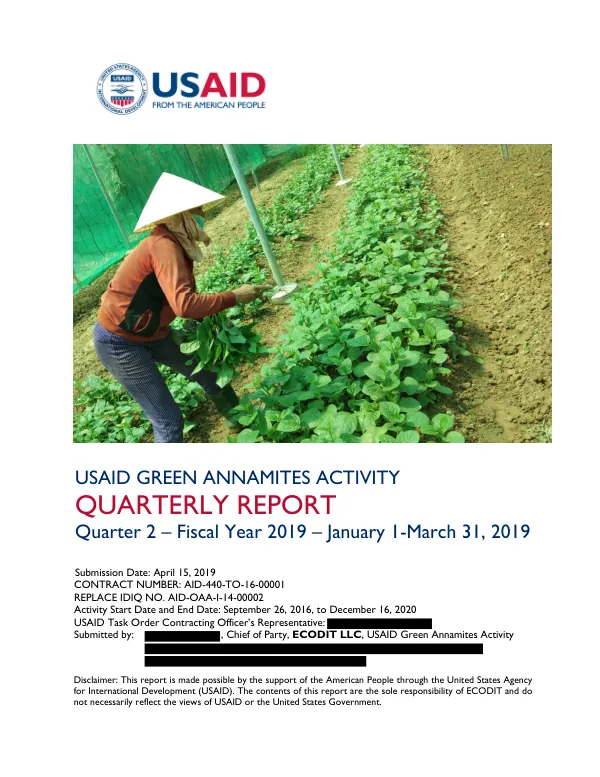
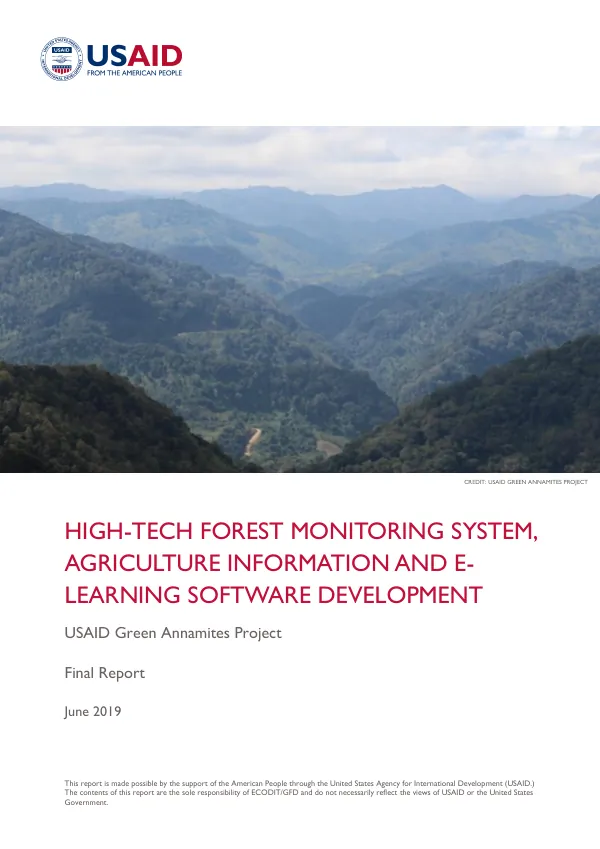
Final Report: USAID Green Annamites Project
The USAID Green Annamites Project supports Vietnam's transition to climate-smart, low emission, and resilient development in Quang Nam and Thua Thien Hue provinces.
2019 · 52 pages
Sign in to readA free account is required to download.
Abstract
The project's main tasks include increasing the application of low emission land use, strengthening biodiversity conservation, and increasing resilience for vulnerable communities. One of the priority activities is to improve forest monitoring capacity through the employment of new technology. The project's work package, completed by GFD from April 2018 to May 2019, included building capacity for stakeholders in the application of tablet-based forest monitoring systems. Training for forest rangers and relevant staff in the project's two target provinces on the usage of Forest Resource Monitoring System (FRMS) mobile software was conducted. The software, designed by the JICA Project for Sustainable Natural Resource Management (SNRM), has been received and put into use by the Vietnam Administration of Forestry. In Quang Nam, training courses were conducted for 25 Trainers of Trainers and 175 participants from all provincial Forest Protection Departments (FPDs). In Thua Thien Hue, 50 forest rangers and staff from nature reserve areas in the province were trained. The FRMS mobile system recorded 746 forest changes incidents (equivalent to 1,108 hectares) in Quang Nam and 475 forest change incidents (equivalent to 812 hectares) in TT Hue during 2018 and 2019. The FRMS mobile application has been applied effectively, with 399 FRMS mobile accounts registered in TT Hue compared to the number of 138 tablets transferred by projects. In Quang Nam, 252 accounts were registered compared to 225 transferred tablets. The forest monitoring system (FMS) allows automatic connection to forest change detection tools from Google Earth Engine satellite images of the JICA SNRM project. Once every 10 days, the FMS system will put new deforestation warning points on the WebGIS portal and send warnings about the location and area to forest managers, including the FPD, commune forest rangers, and forest owners in Group II who manage large areas of forest in the province. The FMS system has integrated most of the professional data layers on forest resources, including administrative boundaries, compartment boundaries, planning 3 types of forests, and bo. The FMS system also includes a Farmer Information Portal (FIP) that allows farmers to access information on forest management, forest products, and market prices. The FIP has been integrated with the FMS system, enabling farmers to report forest changes and receive warnings about deforestation. The FIP has been tested and trained for use by farmers in Quang Nam and Thua Thien Hue provinces. The project has also developed an E-learning system, which has been integrated with the FMS system. The E-learning system provides training for forest rangers and farmers on forest management, forest products, and market prices. The E-learning system has been tested and trained for use by forest rangers and farmers in Quang Nam and Thua Thien Hue provinces. The project's results include the development of a high-tech forest monitoring system in 2 project provinces, the capacity building of stakeholders in the application of tablet-based forest monitoring systems, and the development of an E-learning system. The project has also recorded 746 forest changes incidents (equivalent to 1,108 hectares) in Quang Nam and 475 forest change incidents (equivalent to 812 hectares) in TT Hue during 2018 and 2019. The project's recommendations include the continued development and improvement of the FMS system, the expansion of the FIP and E-learning system to other provinces, and the strengthening of the capacity building program for stakeholders. The project's results and recommendations will contribute to the improvement of forest monitoring capacity in Vietnam and the achievement of the project's objectives.