USAID DEC
Labor Market Supply and Demand Survey: Afghanistan Workforce Development Program (AWDP)
Sign inCREATIVE ASSOCIATES INTERNATIONAL INC.
Labor Market Supply and Demand Survey: Afghanistan Workforce Development Program (AWDP)
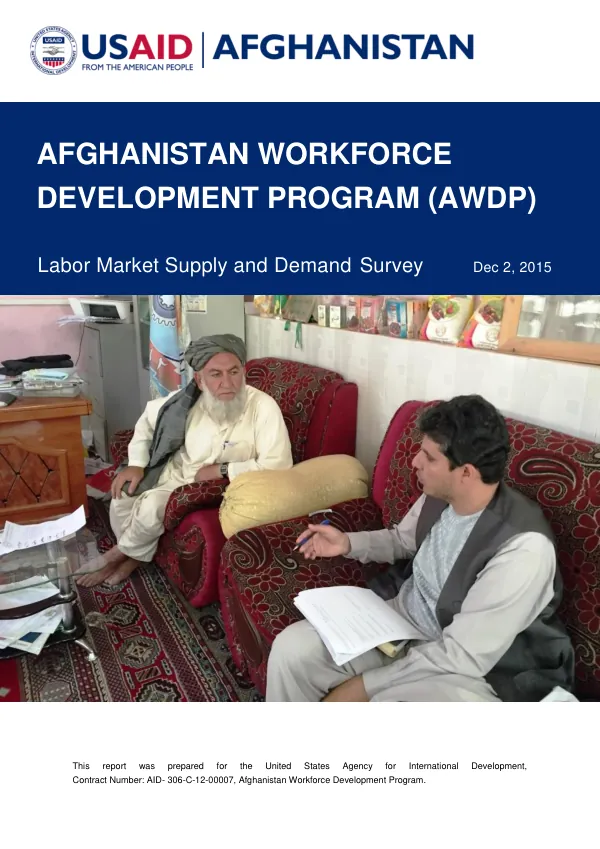
The Afghanistan Workforce Development Program (AWDP) conducted a Labor Market Supply and Demand Survey in 2015 to assess the changing economic climate and inform current and future workforce development programming.
2015 · 42 pages
Sign in to readA free account is required to download.
Abstract
The survey aimed to identify skillsets, sectors, and geographic areas with the most potential to benefit from short-term competency-based skills training and employment-related services. The AWDP's periodic macro-level labor market research has been conducted since 2012, with three previous surveys conducted in 2012, 2013, and 2014. The surveys have provided valuable insights into the needs of private sector employers and jobseekers, enabling the program to adapt its services to meet the evolving demands of the labor market. The 2015 survey was conducted by a four-person research team in the program's six current target regions of Kabul, Mazar-e Sharif, Kandahar, Herat, Jalalabad, and Kunduz. Semi-structured interviews were conducted with private sector employers and jobseekers to gather information on their perceptions of the economic situation, business enabling environment, and demand for skills and training. The survey results indicate that the needs of private sector employers and jobseekers have evolved significantly over the past 18 months due to various political and economic factors. These factors include a decline in local and foreign direct investment, rising unemployment, a five-month national election process, ongoing security concerns, and a severe decline in public sector spending following the withdrawal of the majority of multi-national forces. The survey highlights the importance of identifying the most promising target skillsets, sectors, and geographic areas for workforce development programming. The results suggest that the AWDP should focus on providing training and employment-related services in areas such as construction, manufacturing, and services, which are in high demand by private sector employers. The survey also identifies the most promising target skillsets, including skills related to construction, manufacturing, and services. The results indicate that the AWDP should prioritize the development of these skills to meet the demands of the labor market. In terms of geographic areas, the survey suggests that the AWDP should focus on the regions of Kabul, Mazar-e Sharif, and Kandahar, which have the highest demand for skills and training. The results also indicate that the AWDP should consider expanding its services to other regions, such as Herat and Jalalabad, which have a growing demand for skills and training. Overall, the 2015 Labor Market Supply and Demand Survey provides valuable insights into the changing economic climate and the evolving needs of private sector employers and jobseekers in Afghanistan. The survey results will inform current and future workforce development programming, enabling the AWDP to adapt its services to meet the demands of the labor market and contribute to the country's economic development. The survey results also highlight the importance of addressing the barriers and opportunities for workforce development programs in Afghanistan. The results suggest that the AWDP should prioritize the development of skills related to construction, manufacturing, and services, and focus on the regions of Kabul, Mazar-e Sharif, and Kandahar, which have the highest demand for skills and training. In terms of implementation, the AWDP should consider the following recommendations: * Prioritize the development of skills related to construction, manufacturing, and services * Focus on the regions of Kabul, Mazar-e Sharif, and Kandahar, which have the highest demand for skills and training * Expand services to other regions, such as Herat and Jalalabad, which have a growing demand for skills and training * Address the barriers and opportunities for workforce development programs in Afghanistan, including the need for more effective marketing and outreach strategies, and the importance of engaging with private sector employers and jobseekers. By implementing these recommendations, the AWDP can contribute to the country's economic development and improve the livelihoods of Afghan citizens.