AFGHANISTAN MINISTRY OF AGRICULTURE, IRRIGATION AND LIVESTOCK
ASAP Global Economic Impact Study
The Accelerating Sustainable Agriculture Program (ASAP) was a nationwide program in Afghanistan that aimed to accelerate broad-based, market-led agriculture development.
2011 · 28 pages
Sign in to readA free account is required to download.
Abstract
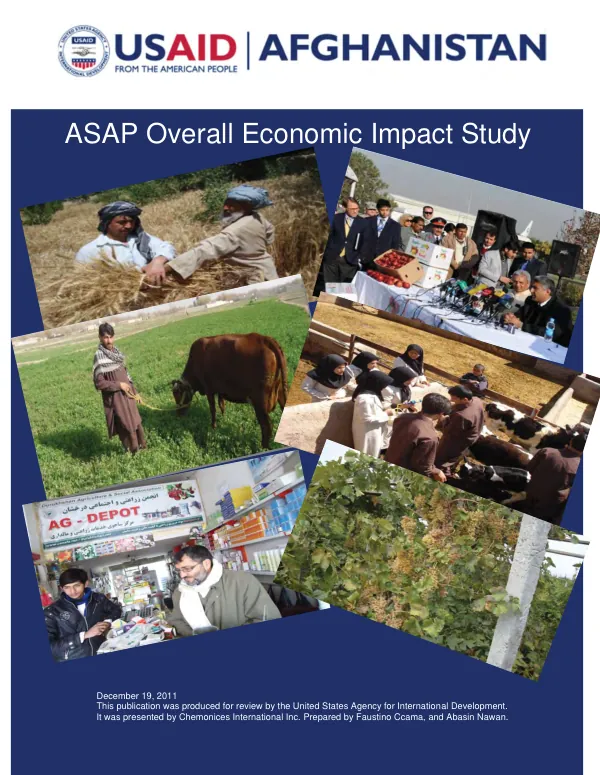
The program was funded by the United States Agency for International Development (USAID) and was implemented from November 2006 to September 2011. ASAP's main objective was to accelerate sales of high-value commodities and improve the capacity of the Government of Afghanistan to formulate agriculture sector policies and strategies. ASAP implemented various successful programs to contribute to the agricultural development of Afghanistan. The program focused on improving farmers' access to inputs, establishing effective extension services, and invigorating agribusinesses by increasing linkages between farmers, markets, credit, and trade corridors. ASAP also strengthened the capacity of the Ministry of Agriculture, Irrigation, and Livestock to deliver services and promote private sector development. The program's results were measured in terms of indicators, including total incremental sales, new full-time employment created, families benefited, hectares supported, and new technologies introduced. The actual results showed that ASAP achieved significant impacts, including: - Total incremental sales of US $57.2 million - New full-time employment created of almost 8,000 - Benefitting around 1.2 million families across all of Afghanistan - Supporting 23,000 hectares - Supporting 11 women's organizations - Training over half a million farmers, herders, traders, and students - Supporting 17 new technologies ASAP also supported the expansion and strengthening of a network of at least 888 privately-owned businesses, including Ag Depots, VFUs, traders, and women organizations. These businesses generated an average of US $17.6 million of net income per year. ASAP implemented an aggressive extension training program for farmers and herders, reconstructed the Badam Bagh farm as an agricultural research and extension unit, and established 300 demonstration plots across Afghanistan. To support post-harvest activities, ASAP constructed a pack house at Badam Bagh, which was Hazard Analysis and Critical Control Points (HACCP)-compliant. Afghan traders and producers used the pack house to sort, grade, and pack fresh fruit and vegetables for export abroad and to supply locally. ASAP also created Afghan GAP (Afghan Good Agricultural Practices) and supported post-harvest activities, including training in cold storage, processing plants, and agricultural export. The estimated net income of ASAP business supported sums to US $101 million, which includes the income generated by businesses supported by ASAP during the last 5 years plus expected income in the near future 3 years. In general, ASAP clients-beneficiaries were satisfied with ASAP support, and the businesses supported by ASAP were sustainable per se as businesses. Most of the businesses supported by ASAP were currently active and growing, and 88 percent of VFU owners responded that their business would continue without ASAP support.