USAID DEC
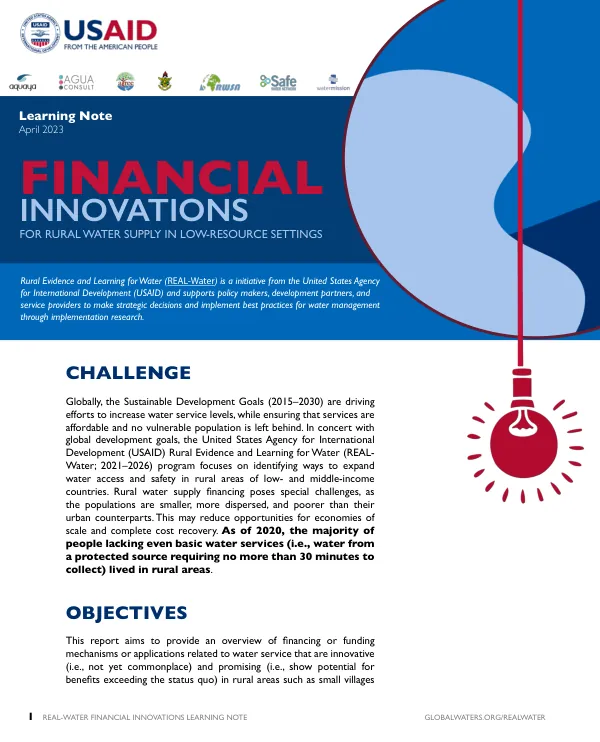
Financial Innovations for Rural Water Supply in Low-Resource Settings: Learning Note
Sign inUSAID DEC
Financial Innovations for Rural Water Supply in Low-Resource Settings: Learning Note
Rural Evidence and Learning for Water (REAL-Water) is a USAID initiative that aims to improve water management through implementation and decision-making support for policymakers, development partners, and service providers.
2023 · 10 pages
Sign in to readA free account is required to download.
Abstract
The program focuses on identifying ways to expand water access and safety in low- and middle-income countries, particularly in rural areas. The Sustainable Development Goals (SDGs) 2015-2030 drive efforts to increase water service levels while ensuring services are affordable and accessible to vulnerable populations. As of 2020, the majority of people lacking basic water access lived in rural areas. The REAL-Water program seeks to address this challenge by exploring innovative financing mechanisms for rural water supply. Community-based savings and credit associations offer rural dwellers in low-income settings an opportunity for member-only access to loans, emergency support, and investment returns. These groups have been leveraged in some cases to improve financial management of rural water systems. They provide a framework for creating dedicated, affordable, and transparent savings funds to pay for high-quality maintenance and repairs. Digital financial services have penetrated many aspects of life, including water services. Prepaid metering of water dispensing devices and postpaid digital water service accounts provide benefits for both water system operators and customers, improving fee collection consistency and convenience. However, converting to digital services brings added transaction fees and startup infrastructure challenges. Local training and social inclusion outreach are essential for digital service expansion. Water quality assurance funds can reduce the risk of newer markets such as water supply testing services. External guarantees ensure on-time payment, leveraging development aid as a backstop for mostly self-sufficient local business arrangements. This approach improves efficiency and incentives for wider-scale testing, but requires oversight and quality control. Development impact bonds move some risks from service providers and primary donors to a third-party investor, rewarding water development outcomes. After designing a funding arrangement, the social investor gives the service provider added capital for planned activities. Once outcomes are verified, the primary investor reimburses the other investor, adding interest or subtracting losses depending on outcome performance. Performance-based funding is designed to maximize accountability and efficiency of the service provider. Its elements include: (a) repayment ceilings, (b) agreed payment amounts for each service, and (c) independent verification of results prior to disbursement. This mechanism can accelerate efficiency and accountability if designed well and if service providers participate. Standardized life-cycle costing allows visualization, comparison, and targeted fundraising to better match anticipated costs. Consistent guidance on this approach has been provided for rural water supply, consisting of six cost categories. However, it has seen limited application and data sharing in low- and middle-income countries. Blended finance refers to leveraging public funds to mobilize additional capital from private banks or investment groups. This approach is growing, especially for attractive recipients such as well-run water utilities. For rural water supply, limited applications have taken root in Madagascar, Benin, and Senegal. Innovative financing mechanisms for rural water supply have several benefits, including self-sufficiency for several years with external support, robust accountability mechanisms, social capital among members, and fee collection efficiency. These mechanisms also provide long-term support for local capacity building and offer a cost-efficient approach for donors.