USAID DEC
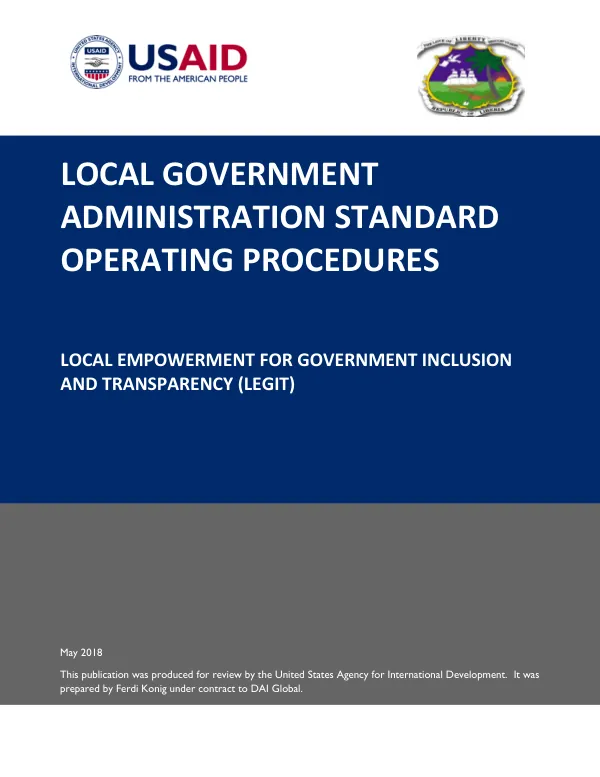
Fiscal Year 2016 Activity Implementation Report: Local Empowerment for Government Inclusion and Transparency (LEGIT)
Sign inDAI
Fiscal Year 2016 Activity Implementation Report: Local Empowerment for Government Inclusion and Transparency (LEGIT)
The Local Empowerment for Government Inclusion and Transparency (LEGIT) project is a three-year initiative aimed at increasing the accountability, transparency, and effectiveness of sub-national government resources in Liberia.
2016 · 36 pages
Sign in to readA free account is required to download.
Abstract
The project is a task order under the Making Cities Work Indefinite Delivery Indefinite Quantity (IDIQ) and is implemented by DAI with support from subcontractors Humanitarian OpenStreetMap Team (HOT) and National Opinion Research Center (NORC) at the University of Chicago. The project's primary objective is to increase the capacity of government institutions to implement national policy on decentralization and local governance. This involves strengthening the capacity of county administrations to coordinate and provide oversight of government activities across sectors, improving the capacity of cities to manage revenues and deliver key services, and increasing citizen representation in planning and decision-making of service delivery in counties and cities. To achieve these objectives, LEGIT will provide technical assistance to the Ministry of Internal Affairs and Governance Commission as they lead, monitor, and coordinate the implementation of the government's decentralization agenda. The project will also support participatory decision-making approaches that can improve citizen participation and monitoring of existing and future services provided at the sub-national level. During the startup phase, the LEGIT management team established relationships with project stakeholders and counterparts in the USAID Liberia Mission, the Government of Liberia, and other donors. The team also undertook major technical activities, including the assessment and selection of counties and cities for project implementation, development of the project Activity Monitoring, Evaluation and Learning Plan (AMELP), and the development of the project Grants Manual and guide for grant applicants. The LEGIT project comprises four complementary components, including increased capacity of government institutions, improved performance and strengthened capacity of county administrations, improved capacity of cities to manage revenues and deliver key services, and increased citizen representation in planning and decision-making of service delivery in counties and cities. The project's implementation will be supported by a team of qualified Liberian candidates recruited for open positions in the Monrovia office, and project management systems and operations will be established in the Monrovia office. The LEGIT project has established relationships with various stakeholders, including the Government of Liberia, local authorities, civil society organizations, and media organizations. The project's technical activities during the startup phase have laid the foundation for full implementation, and the project is poised to make significant contributions to the decentralization and local governance agenda in Liberia. The LEGIT project's focus on increasing citizen participation and monitoring of services provided at the sub-national level is critical to ensuring that government resources are used effectively and transparently. The project's emphasis on strengthening the capacity of county administrations and cities to manage revenues and deliver key services will also contribute to improved service delivery and economic development in Liberia. The LEGIT project's implementation will be closely monitored and evaluated through the Activity Monitoring, Evaluation and Learning Plan (AMELP), which will provide a framework for assessing progress towards project objectives and identifying areas for improvement. The project's results will be reported regularly to stakeholders, including the USAID Liberia Mission, the Government of Liberia, and other donors. Overall, the LEGIT project is a critical initiative aimed at promoting transparency, accountability, and effective governance in Liberia. The project's focus on increasing citizen participation and monitoring of services provided at the sub-national level, strengthening the capacity of county administrations and cities, and improving service delivery and economic development will contribute significantly to the country's development agenda.