USAID DEC
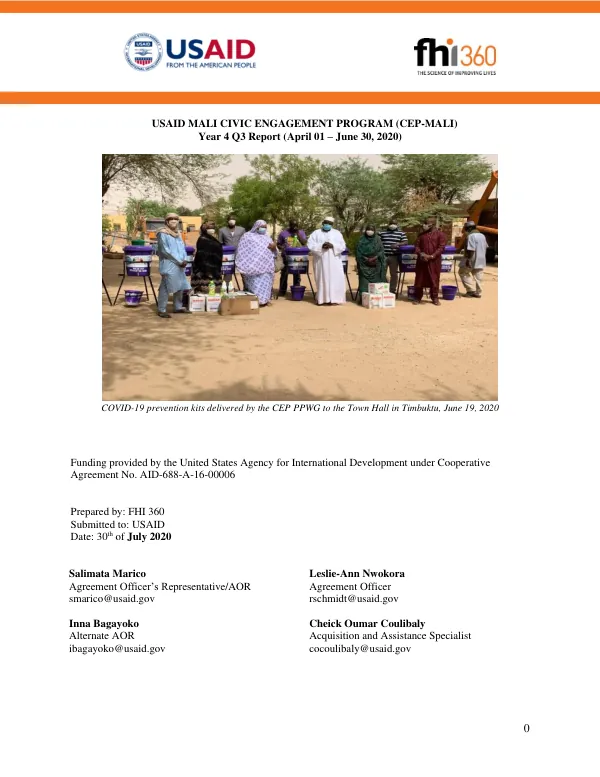
USAID MALI CIVIC ENGAGEMENT PROGRAM (CEP-MALI) Year 4 Report (October 01, 2019 – September 30, 2020)
Sign inFAMILY HEALTH INTERNATIONAL 360
USAID MALI CIVIC ENGAGEMENT PROGRAM (CEP-MALI) Year 4 Report (October 01, 2019 – September 30, 2020)
The Mali Civic Engagement Program (CEP) is a five-year initiative implemented by Family Health International (FHI 360) in Mali, with funding from the United States Agency for International Development (USAID).
2020 · 66 pages
Sign in to readA free account is required to download.
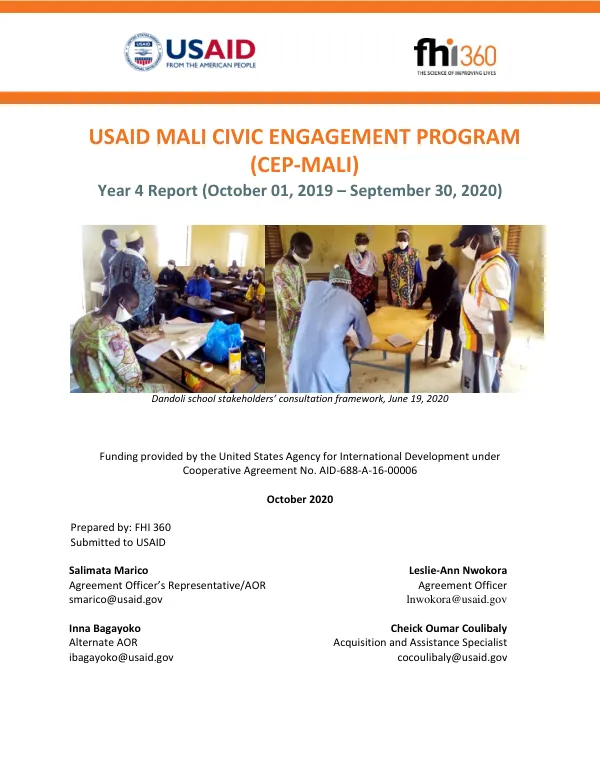
Abstract
The program aims to improve public accountability by increasing and strengthening citizens' role in the community development process. CEP focuses on achieving three main objectives: 1) strengthened mechanisms of bottom-up social accountability, 2) improved effective collaboration among civil society organizations (CSOs), the Government of Mali (GoM), and the private sector to develop public policy and advance issues of common interest, and 3) increased citizen understanding of rights and responsibilities to feel empowered to engage with the GoM. To achieve these objectives, CEP provides sub-awards and technical assistance to a core group of CSOs responsible for advocating to improve the delivery of basic services across five regions of Mali and the District of Bamako. The program also works with subcontractors to address community-specific needs related to civic engagement in target program areas and at the national level. CEP supports local communities in playing an active role in fulfilling their part of the Malian social contract, and in giving communities the tools and resources they need to improve accountability in the governance system. During the 2020 fiscal year (FY) / Year 4 (Y4) of CEP implementation, the program completed several activities despite national security challenges. Under objective 1, CEP continued to implement its 8 Good Governance Barometer (GGB) processes, held 237 forums to strengthen community groups' participation in decision-making processes, and conducted 157 advocacy initiatives for the improvement of the quality of basic social services at the community level. Under objective 2, CEP finalized two SCALE + Small Grant packages for the implementation of youth citizenship forums and capacity building of social services management bodies, continued to monitor activities of public-private partnership working groups, and organized 36 training sessions on conflict prevention and management techniques for 149 community-based organizations (CBOs). CEP also participated in several meetings with other USAID partners for synergy actions and continued communication efforts with its CSOs and CBOs partners to support effective collaboration between government, civil society, and the private sector. Under objective 3, CEP organized 110 training sessions on transparency, accountability, local governance, and gender inclusion, held 835 awareness sessions on local governance, local budgeting, accountability, advocacy on national legal texts and instruments on governance, improving service delivery, inclusion, and strengthening civic engagement, and produced and broadcasted civic engagement radio programs through Studio Tamani and community radios stations partners. The program also monitored activities of its subcontractors contributing to increase communities' understanding of their rights and responsibilities to feel empowered to engage with the GoM. The country's political and security context remains challenging, with more than 1340 security incidents recorded in Mali during this reporting period, causing deaths among civilians and the military and increasing the number of displacements. The areas most affected by violent conflicts are in central and northern Mali. Despite these challenges, CEP continues to implement its activities to improve public accountability and civic engagement in Mali.