USAID DEC
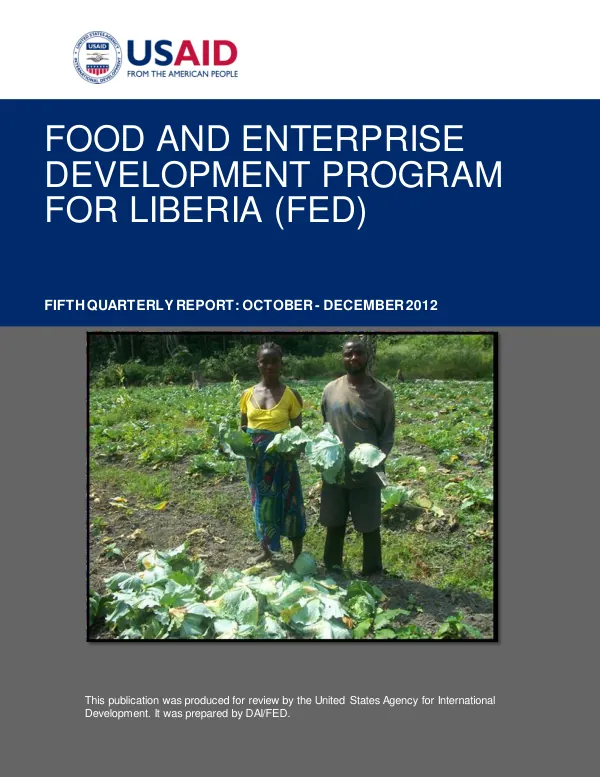
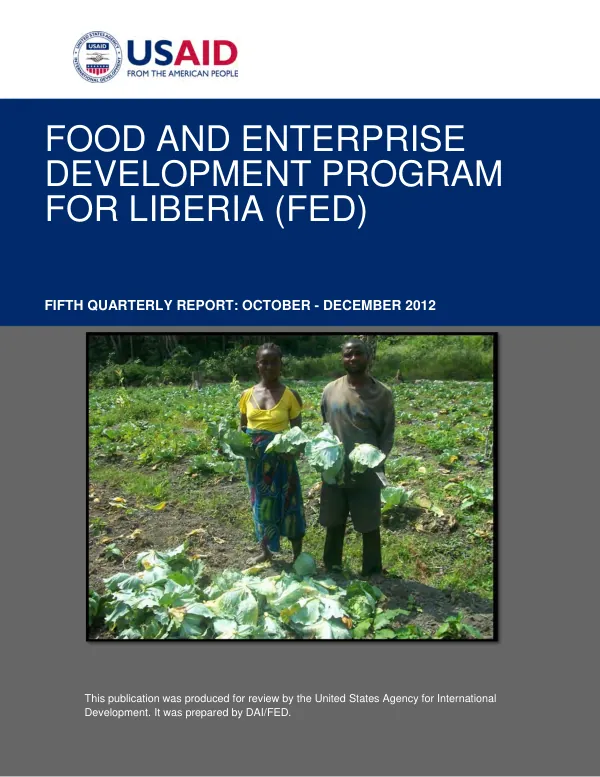
Food and Enterprise Development (FED) Program for Liberia: Fifth Quarterly Report: October – December 2012
Sign inCATHOLIC RELIEF SERVICES ORGANIZATION
Food and Enterprise Development (FED) Program for Liberia: Fifth Quarterly Report: October – December 2012
The Food and Enterprise Development (FED) Program for Liberia is a USAID-funded initiative aimed at improving agricultural productivity and stimulating private enterprise in Liberia.
2012 · 72 pages
Sign in to readA free account is required to download.
Abstract
The program operates in three main components: Increased Agricultural Productivity, Stimulate Private Enterprise, and Build Local Human Capacity. Increased Agricultural Productivity is the first component of the FED program. This component focuses on improving agricultural productivity through various interventions, including input supply, agriculture extension, and mechanization. In the fifth quarter, the program achieved several key milestones, including the training of agro-dealers in Margibi and Bong Counties, profiling of agro-input dealers, and the display of agro-inputs by Wienco. Additionally, the program implemented task 1.7, peri-urban vegetable production, and task 1.8, goat interventions. The second component of the FED program is Stimulate Private Enterprise. This component aims to stimulate private enterprise in the agricultural sector through various activities, including profiling commercial buyers and activity, targeted technical support, and increasing enterprise registration and local government engagement. In the fifth quarter, the program implemented activity 2.3.A.ii.e, targeted technical support, and activity 2.3.B.vi, increase enterprise registration and local government engagement. The program also conducted mobile data collection training, mobile money workshop, and enterprise development and GPS activities. The third component of the FED program is Build Local Human Capacity. This component focuses on building local human capacity through the creation of centers of excellence, vocational training, and technical assistance. In the fifth quarter, the program established Lofa County Community College and Grand Bassa County Community College as centers of excellence. The program also provided technical assistance to the Ministry of Education and conducted monitoring and evaluation activities. The FED program operates in several counties in Liberia, including Margibi, Bong, Lofa, and Grand Bassa. The program has achieved several key milestones in the fifth quarter, including the training of agro-dealers, profiling of agro-input dealers, and the display of agro-inputs. The program has also implemented various activities aimed at stimulating private enterprise and building local human capacity. The FED program has a strong focus on monitoring and evaluation, with several activities conducted in the fifth quarter to assess the program's progress. The program has established a performance indicator database system (PIDS) to track progress and identify areas for improvement. The program has also conducted field travel and monitoring and evaluation activities to assess the program's impact. Overall, the FED program has made significant progress in the fifth quarter, achieving several key milestones in increased agricultural productivity, stimulating private enterprise, and building local human capacity. The program continues to operate in several counties in Liberia, with a strong focus on monitoring and evaluation to ensure the program's effectiveness and impact.
Related documents