USAID DEC
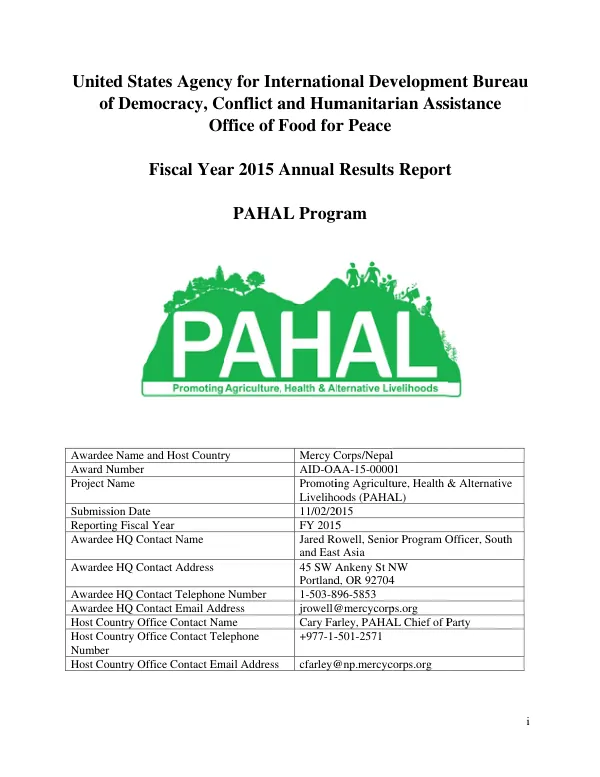
Promoting Agriculture, Health and Alternative Livelihoods (PAHAL) Program Annual Report FY 2015
Sign inMERCY CORPS INTERNATIONAL
Promoting Agriculture, Health and Alternative Livelihoods (PAHAL) Program Annual Report FY 2015
The Promoting Agriculture, Health and Alternative Livelihoods (PAHAL) program is a $37 million, five-year initiative designed to achieve food security among vulnerable populations in 14 districts in the middle and high hills of Far Western and Mid-Western Nepal.
2016 · 40 pages
Sign in to readA free account is required to download.
Abstract
The program is a Development Food Assistance Project under the Bureau for Democracy, Conflict and Humanitarian Assistance (DCHA)/Office of Food for Peace (FFP) that takes a multi-dimensional, systems approach to address the underlying socio-political, economic and ecological constraints, and the related shock and stress exposure that drive food insecurity in Nepal. The program's sub-purposes form the resilience pathway in which to enable people in vulnerable communities to better cope with and absorb shocks and stresses, and to adapt health and livelihood strategies of people from vulnerable communities to effectively reduce exposure to shocks and stresses. The program aims to achieve this by addressing the root causes of food insecurity, including poverty, lack of access to markets, and limited agricultural productivity. The PAHAL program focuses on six sub-outputs, including increased access to quality health and nutrition services and information, better access to improved water, sanitation, and hygiene services, improved access to effective disaster risk management services, improved access to appropriate and diverse financial services and products, improved access to dynamic and responsive agricultural and non-agricultural markets, and improved access to productive natural resources and resource management systems. Implementation of the program is led by Mercy Corps/Nepal, with support from various local and international partners. The program's activities are designed to be context-specific and responsive to the needs of the target communities, with a focus on empowering vulnerable populations to take ownership of their development. The program's approach is based on a theory of change that outlines the expected outcomes and impact of the program's activities. The theory of change is grounded in a deep understanding of the root causes of food insecurity in Nepal and the need for a multi-dimensional approach to address these challenges. The PAHAL program has made significant progress in its first year, with a focus on establishing a strong foundation for the program's activities and building partnerships with local stakeholders. The program has also made significant investments in capacity building and training for local partners and staff, with a focus on building the skills and knowledge needed to implement the program's activities effectively. The program's monitoring and evaluation framework is designed to track progress against the program's objectives and outcomes, with a focus on ensuring that the program is meeting its intended impact. The framework includes a range of indicators and metrics that will be used to assess the program's progress and identify areas for improvement. Overall, the PAHAL program is a critical initiative that aims to address the root causes of food insecurity in Nepal and promote sustainable development among vulnerable populations. The program's multi-dimensional approach and focus on empowering local communities make it a unique and effective response to the challenges facing Nepal.