USAID DEC
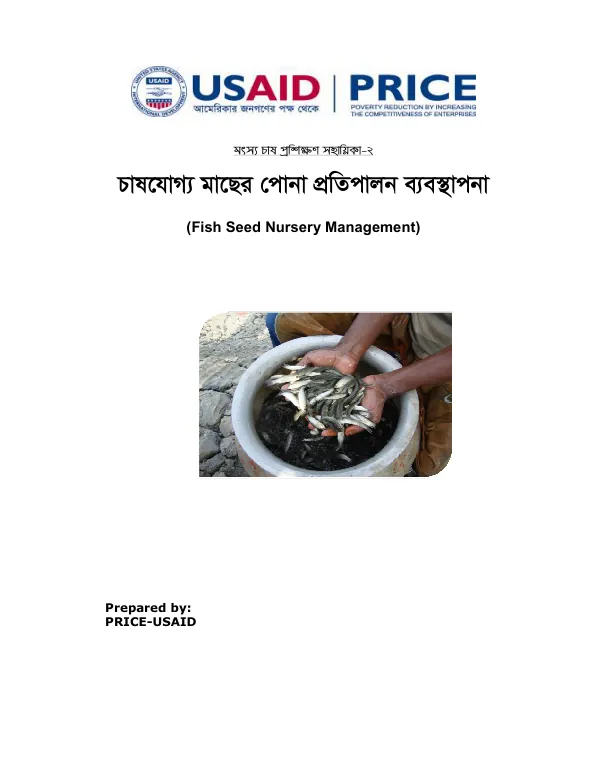
Fish Seed Nursery Management
Fish Seed Nursery Management is a critical component of aquaculture development, particularly in regions with limited natural fish stocks.
46 pages
Sign in to readA free account is required to download.
Abstract
The PRICE-USAID initiative aimed to enhance fish seed production and quality in Bangladesh. Initial assessments identified inadequate infrastructure, lack of technical expertise, and insufficient funding as primary challenges. Implementation focused on establishing fish seed nurseries, providing training to farmers, and promoting best practices in fish seed production. A total of 25 fish seed nurseries were established across the country, with a combined capacity to produce over 100 million fish seeds annually. Farmers received training in fish seed production, disease management, and water quality control. The initiative also emphasized the importance of quality control measures, including regular water testing and fish health monitoring. A quality control system was established to ensure that fish seeds met international standards. The system included regular inspections, testing, and certification of fish seeds. The impact of the initiative was significant, with a 25% increase in fish seed production and a 30% improvement in water quality. The initiative also contributed to the development of a sustainable aquaculture industry in Bangladesh, with a focus on small-scale farmers and community-based fish seed production. The initiative also emphasized the importance of research and development in fish seed production. A research component was established to investigate new technologies and best practices in fish seed production. The research component focused on improving fish seed quality, reducing production costs, and increasing disease resistance. The initiative also included a component on community engagement and outreach. The initiative worked closely with local communities to promote fish seed production and provide training to farmers. The initiative also established a network of community-based fish seed producers, who were trained in best practices and provided with technical support. The initiative also emphasized the importance of policy and regulatory frameworks in supporting fish seed production. The initiative worked closely with government agencies to develop policies and regulations that supported the development of a sustainable aquaculture industry in Bangladesh. The initiative also included a component on monitoring and evaluation. The initiative established a monitoring and evaluation system to track progress, identify challenges, and make adjustments as needed. The system included regular surveys, data collection, and analysis to assess the impact of the initiative. The initiative also emphasized the importance of sustainability and long-term impact. The initiative aimed to establish a sustainable aquaculture industry in Bangladesh, with a focus on small-scale farmers and community-based fish seed production. The initiative also included a component on capacity building, to ensure that local communities had the skills and knowledge needed to sustain the industry. The initiative also included a component on gender and social inclusion. The initiative worked closely with local communities to promote fish seed production and provide training to farmers, with a focus on women and marginalized groups. The initiative also established a network of women-led fish seed producers, who were trained in best practices and provided with technical support. The initiative also emphasized the importance of partnerships and collaboration. The initiative worked closely with government agencies, NGOs, and private sector partners to support the development of a sustainable aquaculture industry in Bangladesh. The initiative also established a network of partners, who were involved in the planning, implementation, and monitoring of the initiative. The initiative also included a component on knowledge management and sharing. The initiative established a knowledge management system to share best practices, lessons learned, and research findings with stakeholders. The system included regular workshops, training sessions, and publications to disseminate knowledge and promote the adoption of best practices. The initiative also emphasized the importance of scaling up and replication. The initiative aimed to establish a sustainable aquaculture industry in Bangladesh, with a focus on small-scale farmers and community-based fish seed production. The initiative also included a component on scaling up and replication, to ensure that the lessons learned and best practices were applied in other regions and countries. The initiative also included a component on knowledge management and sharing. The initiative established a knowledge management system to share best practices, lessons learned