USAID DEC
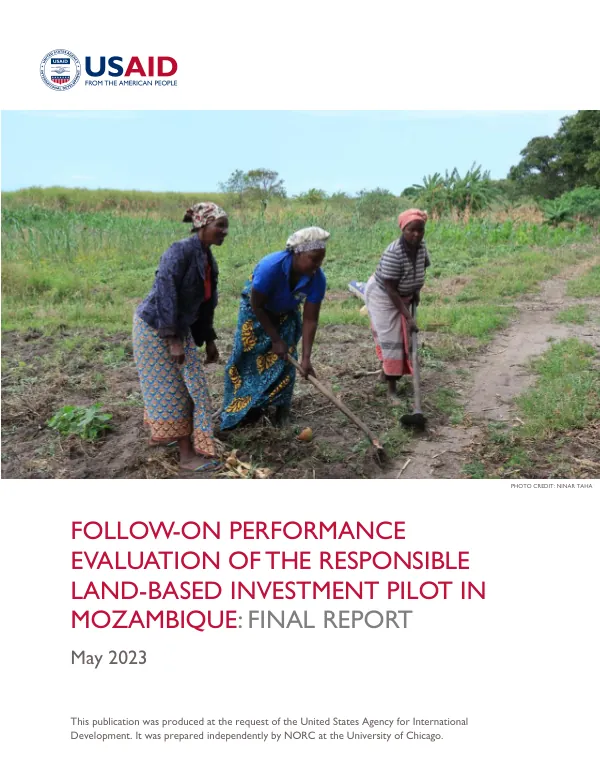
Follow-On Performance Evaluation of the Responsible Land-Based Investment Pilot in Mozambique: Final Report
Sign inNORC AT THE UNIVERSITY OF CHICAGO
Follow-On Performance Evaluation of the Responsible Land-Based Investment Pilot in Mozambique: Final Report
The Responsible Land-Based Investment Pilot in Mozambique was a 3-year program implemented across two phases during 2017-2019 by local implementing partner Terra Firma together with Maragra/Illovo, in Mozambique's Manhiça District.
2023 · 103 pages
Sign in to readA free account is required to download.
Abstract
The program aimed to raise awareness on land rights, conduct participatory land mapping and documentation of landholders' parcels, and provide eligible participants with a certificate to prove acquisition of Land Use and Benefit Rights (DUATs) recognized under Mozambique's 1997 Land Law, issued by a local farmer cooperative. The Pilot's Illovo partnership stemmed from the company's interest to engage in sugarcane outgrower contracts with farmers in the floodplain areas surrounding Maragra while also ensuring that such contracting would be done with farmers who held legitimate rights to the land. This was a particular concern in the floodplain context surrounding Maragra, given a trajectory of land acquisition by outside investors. The Pilot operated in several areas ("blocks") of a low-lying floodplain surrounding Illovo's Maragra sugar estate, where sugarcane production is viable and many farmers had long-standing undocumented rights to land. The follow-on performance evaluation of the Pilot was commissioned by USAID and conducted by NORC at the University of Chicago under the Communications, Evidence, and Learning (CEL) project. The evaluation aimed to understand the longer-term achievements and sustainability of the Pilot, four years after its conclusion. The evaluation questions sought to understand how Pilot activities in general, and the cooperative-issued certificates specifically, have affected participants' perceived land rights knowledge, tenure security, perceptions of, engagement with, and ability to benefit from sugarcane outgrowing schemes, and their broader economic and livelihood situations. The evaluation adopted a non-experimental approach using qualitative and quantitative pre-post analysis to explore the relationship between Pilot activities and outcomes of interest for land users in the Pilot zone. Data collection consisted of 16 qualitative group discussions with farmers who have land parcels in the rehabilitated floodplain, 16 key informant interviews with farmer association leaders, community leaders, sugar estate liaisons, and Pilot local implementing partners, and a telephone survey of 534 Pilot participants. The evaluation findings document the Pilot's broader achievements, explain successes, failures, and unanticipated consequences that may have occurred, and summarize key lessons learned and recommendations to inform planning and implementation of similar efforts in future. The recommendations aim to strengthen future programming that links customary land documentation activities to broader efforts to strengthen land tenure security and minimize risks to communities associated with land-based outgrower opportunities through private firms. The evaluation findings indicate that participation in the Pilot has affected beneficiary perception and engagement with land-based investor companies and outgrower schemes. The Pilot activities have improved land users' perceived land rights knowledge, tenure security, and ability to benefit from sugarcane outgrowing schemes. However, the evaluation also identifies challenges and limitations, including the need for more effective communication and outreach to beneficiaries, and the importance of addressing the root causes of land insecurity and poverty in the region. The evaluation concludes that the Pilot has made significant progress in promoting land rights awareness, documentation, and tenure security among land users in the floodplain. However, the sustainability of these gains depends on continued support and investment in land-based outgrower schemes and other initiatives that promote land tenure security and economic development in the region.