USAID. BUR. FOR POLICY AND PROGRAM COORDINATION. CENTER FOR DEVELOPMENT INFORMATION AND EVALUATION (CDIE)
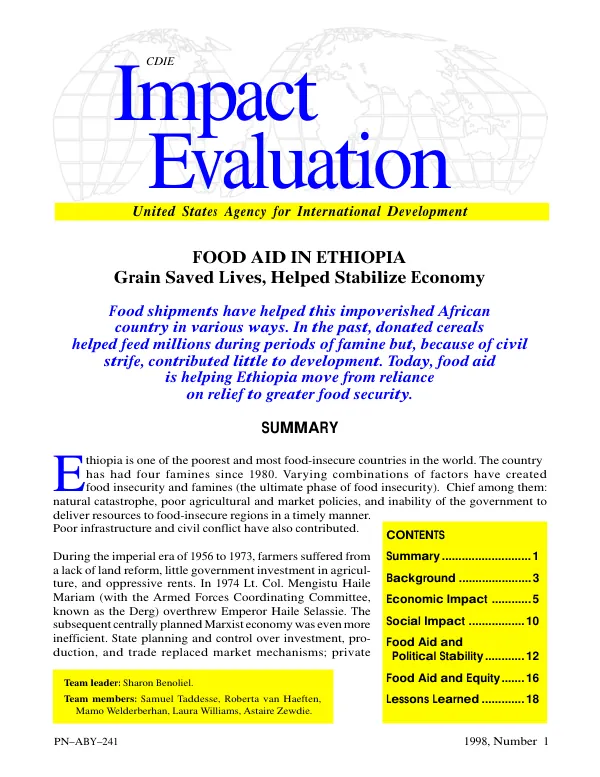
Food aid in Ethiopia : grain saved lives, helped stabilize economy
Since 1956, the United States has provided Ethiopia, mainly via the Title II program, with $773 million in food aid.
Benoliel, Sharon|Taddesse, Samuel · 1997
Sign in to readA free account is required to download.
Abstract
The sum accounts for 28% of all food aid provided the East African country over the past 40 years. This report evaluates the economic, social, and political effects of this aid and identifies its principal beneficiaries. The impact of U.S. food aid to Ethiopia has varied over time. During the reign of Emperor Haile Selassie (1930-74), assistance was small, adding on average less than 2% to the country's foreign exchange earnings. But in late 1973, in response to a famine, USAID increased its allocation of Title II resources from $1 million to nearly $14 million. Though thousands of lives were saved, at least 100,000 were lost. Food insecurity eroded the stability of Haile Selassie's regime, but it would be difficult to prove that U.S. food aid had any significant political impact. Whether earlier introduction of famine relief could have helped save or prolong the regime is uncertain. During Mengistu's Marxist-style regime (1974-91), food aid added somewhat more to the country's foreign exchange resources, but because of the political and economic environment did not contribute to sustainable economic growth. The period 1982-92 saw famine and civil strife, and though malnutrition rates worsened, food aid most likely deflected even higher rates. During 1984-86, U.S. food aid, provided mostly through PVOs, probably saved millions of lives. However, for this period, food aid was used by both the government and (through a cross-border program) the various rebel factions, perhaps helping to prolong the conflict. For the period 1992-95, after the Mengistu regime was replaced by a transitional government, U.S. food aid accounted for 34% of the country's foreign exchange resources. The transfer of agricultural commodities in that period helped jump-start Ethiopia's productive sectors, released money to support other development activities, and helped build the emergency food security reserve and the country's capacity to respond to a 1994 drought. Food assistance also provided a basis for policy dialogue on economic liberalization and food security. Over the past 4 years, the nutritional status of children participating in food-assisted maternal and child health (MCH) programs has improved; food rations may have contributed indirectly to this change by motivating mothers to attend MCH activities (counseling, growth monitoring, and nutrition and health education). Lessons learned from the evaluation are that food aid can: (1) help a country stabilize its economy and provide a basis for policy dialogue on issues critical to food security; (2) unintentionally prolong civil conflict, even when the sole purpose of the aid is humanitarian relief; (3) indirectly contribute to improving children's nutritional status by stimulating mothers' participation in MCH programs; and (4) be an important vehicle for supporting growth strategies and public resource transfers that differentially benefit lower-income groups. (Author abstract, modified)