USAID. BUR. FOR POLICY AND PROGRAM COORDINATION. CENTER FOR DEVELOPMENT INFORMATION AND EVALUATION (CDIE)
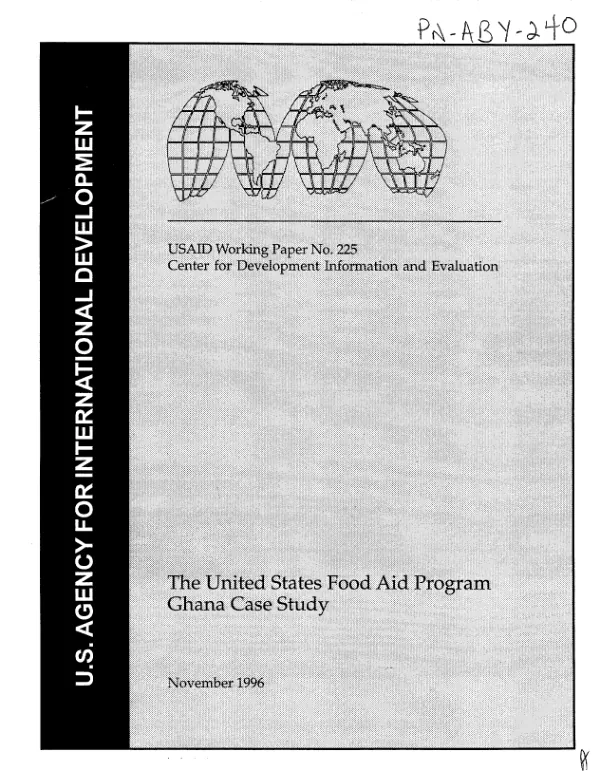
United States food aid program : Ghana case study
This report evaluates the impact of U.S.
Lieberson, Joseph M.|Riley, Barry · 1996
Sign in to readA free account is required to download.
Abstract
food assistance provided Ghana since the early 1960s. Section I discusses the social context for food aid in the country, with consideration for agricultural production and nutritional security. It also examines the social impact of various food aid programs: Title I/II (pre-1991 Title III), Title II (covering assistance provided by the Catholic Relief Service Program, the Adventist Development and Relief Association, the MCH feeding and Food-for-Work Title II programs, and Title II NGO programs), and (post-1991) Title III, covering feeder roads and NGO projects (including those of TechnoServe, Aid to Artisans Ghana, and the Center for Policy Analysis). Section II explores food aid and equity in Ghana, touching on the distribution of poverty and the individual contributions of the Title I, Title II, and Title III programs. Section III examines the direct, indirect, and enabling effects of food aid on political stability, while Sections IV through VI, respectively, outline the evaluation methodology, provide figures and data on food aid, and examine the efficiency of USAID food aid to Ghana. In general, the short-lived Title I program was not a reliable and continuing development resource for Ghana. Title I/II was a second-best resource, next to cash transfers, for both product selection and ease of local currency generation. Because food aid comes from a budget category separate and additive to regular USAID assistance, U.S. was able to provide Ghana with substantial additional assistance that would not have been available otherwise. Title I generally provided Ghana with appropriate commodities. The one exception was vegetable oil, which the United States wanted to unload and which Ghana agreed to accept even though it meets most needs in this area from domestic production and imports from other countries. Finally, the United States faced significant logistical problems moving the commodities within Ghana due to infrastructural adequacies. However, USAID was able to use its policy leverage to bring about the replacement of public food import and distribution systems with private ones. Includes bibliography.
Related documents