USAID DEC
Food and Enterprise Development (FED) Program Activity Highlights January 1st-15th, 2016
Sign inACDI/VOCA
Food and Enterprise Development (FED) Program Activity Highlights January 1st-15th, 2016
The Food and Enterprise Development Program for Liberia (FED) is a USAID-funded initiative aimed at improving agricultural productivity and market access for smallholder farmers in Liberia.
2016 · 1 pages
Sign in to readA free account is required to download.
Abstract
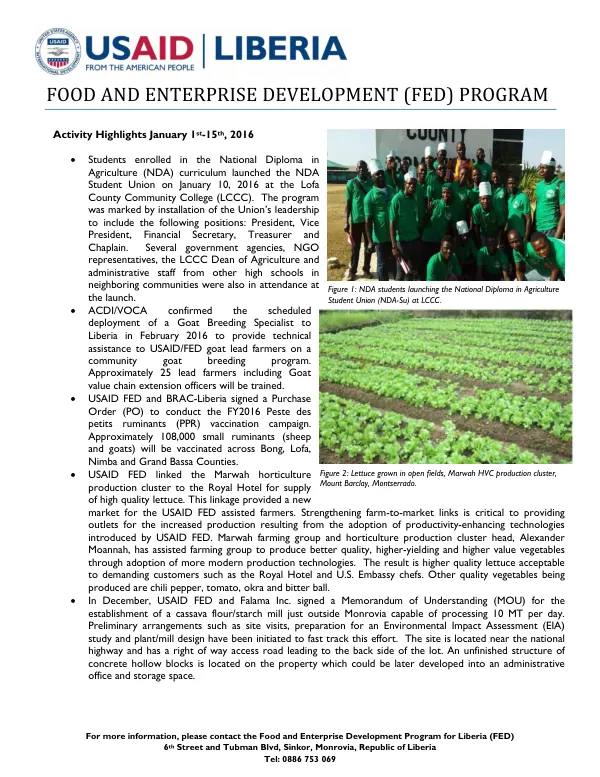
The program's activity highlights for January 1st-15th, 2016, demonstrate significant progress in achieving this goal. The National Diploma in Agriculture (NDA) curriculum at the Lofa County Community College (LCCC) has made notable strides. On January 10, 2016, students enrolled in the NDA program launched the NDA Student Union, marking a significant milestone in the program's development. The installation of the Union's leadership, including positions such as President, Vice President, Financial Secretary, Treasurer, and Chaplain, has provided a framework for student engagement and leadership development. The launch event was attended by government agencies, NGO representatives, the LCCC Dean of Agriculture, and administrative staff from neighboring high schools. The deployment of a Goat Breeding Specialist to Liberia in February 2016 is expected to provide technical assistance to USAID/FED goat lead farmers on a community goat breeding program. Approximately 25 lead farmers, including Goat value chain extension officers, will be trained in this initiative. This training is crucial in enhancing the productivity and quality of goat breeding in Liberia, ultimately contributing to improved food security and income for smallholder farmers. The USAID FED and BRAC-Liberia partnership has led to the signing of a Purchase Order (PO) to conduct the FY2016 Peste des petits ruminants (PPR) vaccination campaign. This campaign aims to vaccinate approximately 108,000 small ruminants (sheep and goats) across Bong, Lofa, Nimba, and Grand Bassa Counties. The PPR vaccination campaign is a critical intervention in preventing the spread of this highly contagious and deadly disease, which has significant economic and social impacts on smallholder farmers. The establishment of a new market linkage between the Marwah horticulture production cluster and the Royal Hotel has provided a significant outlet for high-quality lettuce produced by USAID FED-assisted farmers. This linkage has been facilitated by Alexander Moannah, the head of the Marwah farming group and horticulture production cluster, who has assisted farmers in adopting modern production technologies, resulting in higher-quality lettuce acceptable to demanding customers such as the Royal Hotel and U.S. Embassy chefs. Other quality vegetables being produced include chili pepper, tomato, okra, and bitter ball.