USAID DEC
USAID Food and Enterprise Development Program for Liberia (FED) Bi-Weekly Report October 1-15 2013
Sign inDAI
USAID Food and Enterprise Development Program for Liberia (FED) Bi-Weekly Report October 1-15 2013
The Food and Enterprise Development Program for Liberia (FED) is a USAID-funded initiative aimed at improving agricultural productivity and stimulating private enterprise in Liberia.
2013 · 8 pages
Sign in to readA free account is required to download.
Abstract
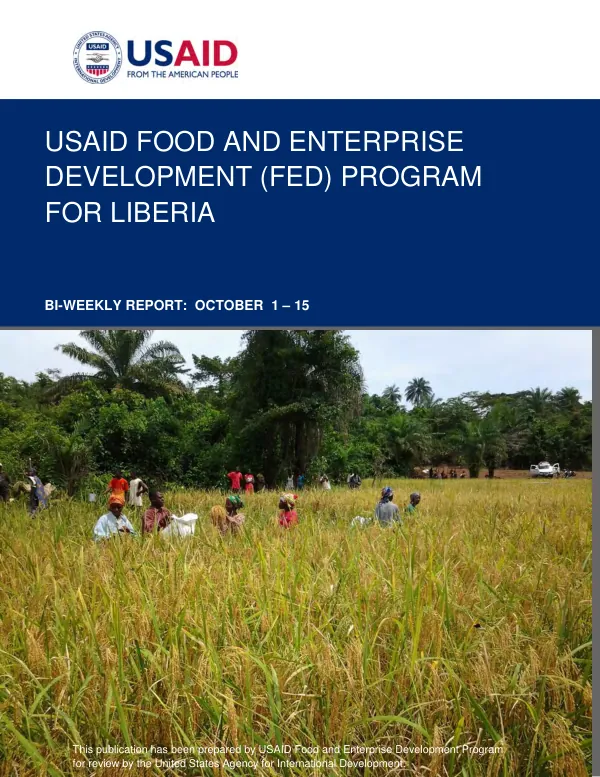
The program is implemented by DAI and focuses on increasing agricultural productivity, stimulating private enterprise, and improving access to finance. Component One: Increased Agriculture Productivity focuses on improving agricultural productivity through input supply, rice value chain development, cassava value chain development, and peri-urban agriculture value chain development. In the rice value chain, FED farmers at UDP lowland rice sites in Bong, Nimba, and Lofa counties have begun harvesting rice, with FED extension officers working with beneficiary farmers to measure and document yields. In Lofa County, farmers at 11 upland rice sites have harvested 0.3ha, while six lowland sites have transplanted 1.7ha and completed weeding on 3.4ha. The cassava value chain study, commissioned by FED and partner ZOA, highlights the importance of quality and taste in consumer purchasing decisions. The study also shows that Grand Cape Mount and Margibi are the largest producers of Gari in Liberia, accounting for 50% of national output. FED's Monrovia-based cassava value chain team conducted field trips to Nimba and Lofa to discuss the implementation of the new strategy and approach for the FY14 Workplan. In the peri-urban agriculture value chain, a total of 3,440 local pepper seedlings were transplanted by Boglondu, Selegai, Latulu, and VODWOPEDE vegetable farming associations in Lofa County. FED trained 121 vegetable farmers in the period in Lofa County. Two vegetable groups in Lofa County reported annual sales, with the Kahenjala generating over L$ 30,000.00 and the Selegai farmers raising over L$5000.00 during FY13. Component Two: Stimulate Private Enterprise focuses on stimulating private enterprise through PUA vegetables, access to finance, and enterprise service centers. In the PUA vegetables component, Iron ore mining concession Western Cluster has expressed an interest in sourcing FED vegetable growers to feed their workers. The potential linkage depends on if the mine's feasibility studies are accepted and the mine is opened. The concession lies 70km from Monrovia by paved road and could employ up to 1000 employees. In the access to finance component, the Village Savings and Loan pilot project groups in Grand Bassa, Montserrado, and Margibi completed their initial training sessions, and 625 female farmers have begun savings. In the enterprise service centers component, consultants Ernest Musinamwana and June Lavelle finished the organizational and market assessments of the five FED-supported Centers of Excellence that will become Enterprise Service Centers. FED's extension team captured footage for developing extension training videos on sampling techniques for rice yield estimation and result demonstrations for different rice production technologies. FED's goat specialists trained 13 participants from seven sites in Grand Bassa County, representing the highest participation of the counties. FED will further assist the newly trained community animal health workers by identifying Agro vets/input providers to supply the community animal health workers in the various counties and linking the two. Overall, the FED program is making significant progress in improving agricultural productivity and stimulating private enterprise in Liberia. The program's focus on increasing agricultural productivity, stimulating private enterprise, and improving access to finance is expected to have a positive impact on the Liberian economy and improve the livelihoods of rural communities.