USAID DEC
Food and Enterprise Development (FED) Activity for Liberia: July 2016 Monthly Report
Sign inDAI
Food and Enterprise Development (FED) Activity for Liberia: July 2016 Monthly Report
The Food and Enterprise Development Activity for Liberia (FED) is a USAID-funded program aimed at improving agricultural productivity and profitability, stimulating private sector growth and investment, and building local technical and managerial human resource capabilities.
2016 · 20 pages
Sign in to readA free account is required to download.
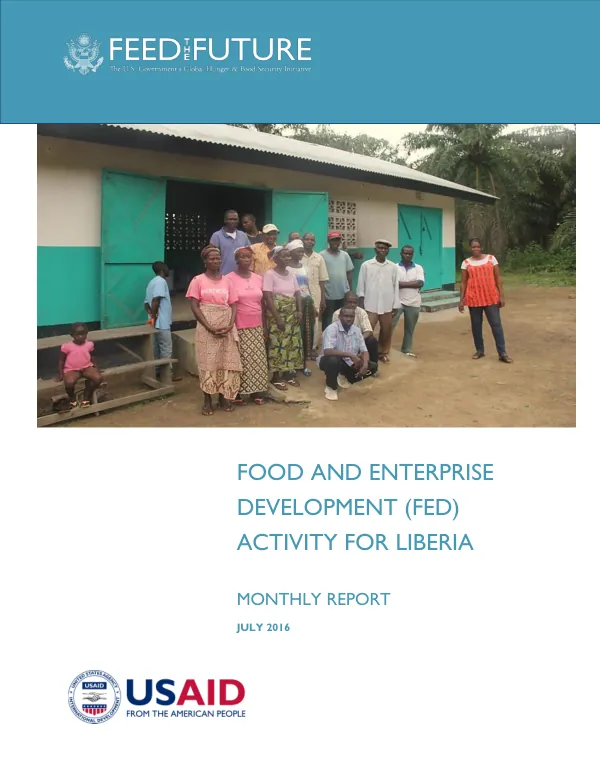
Abstract
The program is implemented by DAI and focuses on four components: increasing agricultural productivity and profitability, stimulating private sector growth and investment, building local technical and managerial human resource capabilities, and cross-cutting activities. Component One: Increase Agricultural Productivity and Profitability focuses on improving the productivity and profitability of the rice, cassava, horticulture, and goat value chains. Task 1A aims to increase the productivity and profitability of the rice value chain through training and support for upland rice farmers. Task 1B focuses on the cassava value chain, with a goal of increasing productivity and profitability through improved access to inputs and extension services. Task 1C targets the horticulture value chain, with a focus on improving productivity and profitability through training and support for vegetable farmers. Task 1D aims to increase the productivity and profitability of the goat value chain through training and support for goat farmers. Subtask 1.2, Improved Access to Agricultural Inputs, focuses on increasing access to inputs such as seeds, fertilizers, and pesticides for farmers. Subtask 1.3, Agricultural Extension Support, provides training and support to extension agents to improve their capacity to provide technical assistance to farmers. Subtask 1.4, Youth in Agribusiness, aims to increase the participation of youth in agribusiness through training and support. Subtask 1.5, Improving Human Nutrition, focuses on improving human nutrition through training and support for farmers on improved agricultural practices. Component Two: Stimulate Private Sector Growth and Investment focuses on creating a policy enabling environment for private sector growth and investment. Task 2 aims to improve access to finance for farmers and agribusinesses through training and support. Subtask 2.1, Access to Finance, focuses on improving access to finance for farmers and agribusinesses through training and support. Component Three: Build Local Technical and Managerial Human Resource Capabilities focuses on building the capacity of local technical and managerial human resources. Activity 3.1, Roll Out the National Diploma in Agriculture (NDA) in All Four CoEs, aims to roll out the NDA program in all four CoEs. Activity 3.4, Enhancing Availability of Textbooks and Reference Materials for the NDA, focuses on enhancing the availability of textbooks and reference materials for the NDA program. Component Four: Cross-Cutting Activities includes tasks such as communications and knowledge management, environmental compliance, and monitoring and evaluation. Task 4.1, Communications and Knowledge Management, focuses on improving communication and knowledge management within the program. Task 4.2, Environmental Compliance, ensures that the program is environmentally compliant. Task 4.3, Monitoring and Evaluation, focuses on monitoring and evaluating the program's progress and impact. The program has made significant progress in its first year, with training and support provided to over 2,500 farmers and agribusinesses. The program has also established 19 Rice Business Hubs to support rice farmers and aggregators in post-harvest production activities. The program has also made progress in improving access to finance for farmers and agribusinesses through training and support.
Related documents