USAID DEC
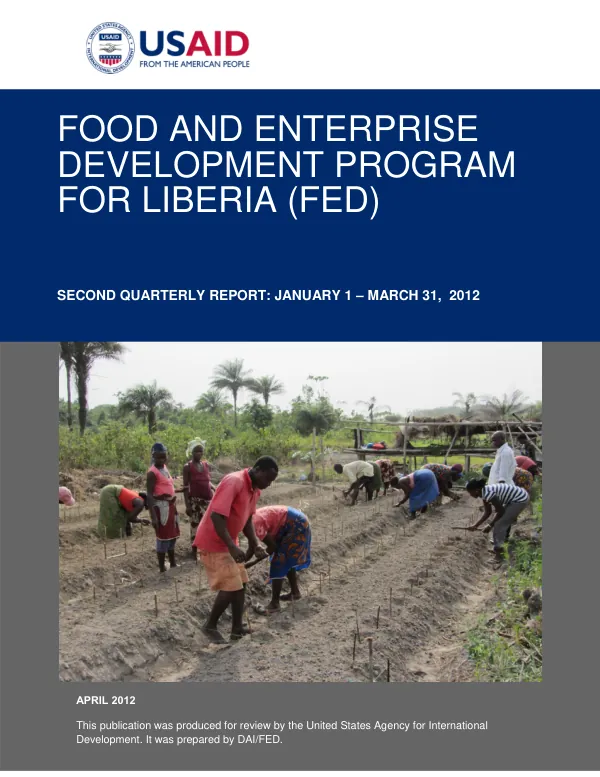
Food and Enterprise Development Program for Liberia (FED) Second Quarterly Report: January 1 – March 31, 2012
Sign inCATHOLIC RELIEF SERVICES ORGANIZATION
Food and Enterprise Development Program for Liberia (FED) Second Quarterly Report: January 1 – March 31, 2012
The Food and Enterprise Development Program for Liberia (FED) is a United States Agency for International Development (USAID) funded project aimed at increasing agriculture productivity, profitability, and access within the rice, cassava, vegetable, and goat value chains.
2012 · 77 pages
Sign in to readA free account is required to download.
Abstract
The program focuses on four priority counties (Grand Bassa, Bong, Nimba, and Lofa) and two secondary counties (Margibi and Montserrado). FED works with partners, including the public and private sectors, to improve productivity, strengthen access to inputs and services, and create market linkages, with a particular focus on women and youth. The program's objectives are to increase agriculture productivity and profitability, improve human nutrition, stimulate private enterprise growth and investment, and build local technical and managerial human resources. FED's activities will link communities to agricultural inputs, extension services, nutritious food products, processing services, market information, transportation, credit, and education and training services. The program aims to lead to substantial income and job growth, as well as major increases in the production, processing, marketing, and nutritional utilization of rice, cassava, and vegetables in the target counties. The program will work with the Ministry of Agriculture and the private sector to achieve its objectives. A Market Development Fund (MDF) will be established to build Liberian capacity and ensure ownership of FED-supported activities prior to the program's conclusion. The MDF will be administered through local subcontracts, partnering across the public sector, private sector, and civil society. In the first quarter of 2012, FED made significant progress in implementing its activities. In Component One, Increased Agricultural Productivity, FED recruited staff and conducted tasks related to peri-urban vegetable production, input supply system interventions, goat interventions, and rice value chain development. The program also conducted a cuttington agriculture show and implemented information and communication technology (ICT) activities. In Component Two, Private Sector Development, FED worked on enabling the policy environment for private sector growth, access to finance, and cross-cutting activities such as environmental compliance and training. The program also conducted baseline surveys and impact studies to assess the effectiveness of its activities. In Component Three, Build Local Human Capacity, FED developed curricula and vocational education programs to build local technical and managerial human resources. The program also conducted data collection and baseline studies to assess the effectiveness of its activities. Overall, FED has made significant progress in implementing its activities and achieving its objectives. The program's focus on increasing agriculture productivity, profitability, and access, as well as building local human capacity, is expected to lead to substantial income and job growth, and major increases in the production, processing, marketing, and nutritional utilization of rice, cassava, and vegetables in the target counties. FED's activities will continue to focus on linking communities to agricultural inputs, extension services, nutritious food products, processing services, market information, transportation, credit, and education and training services. The program will also continue to work with the Ministry of Agriculture and the private sector to achieve its objectives and ensure ownership of FED-supported activities prior to the program's conclusion. The program's geographic focus is on four priority counties (Grand Bassa, Bong, Nimba, and Lofa) and two secondary counties (Margibi and Montserrado). The program's timeframes are not specified in the report, but it is expected to continue until the program's conclusion. Overall, FED's progress in the first quarter of 2012 is a significant step towards achieving its objectives and improving agriculture productivity, profitability, and access in Liberia.