USAID DEC
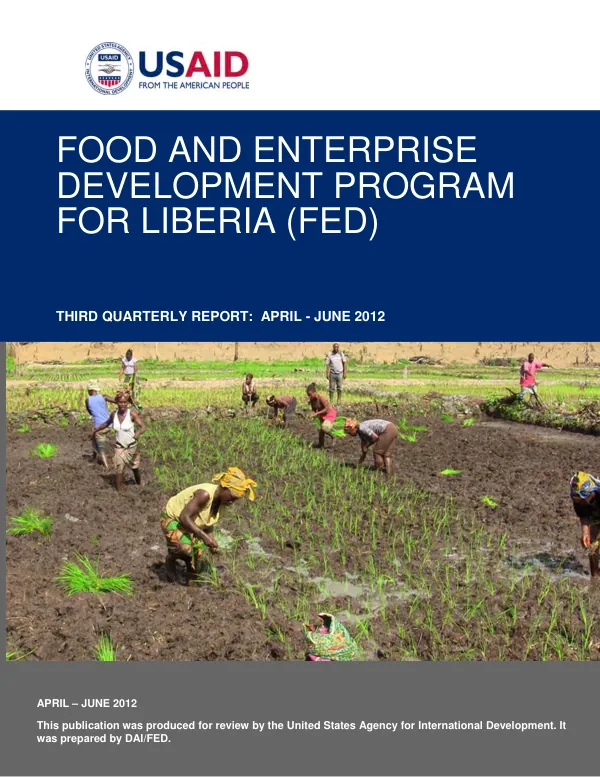
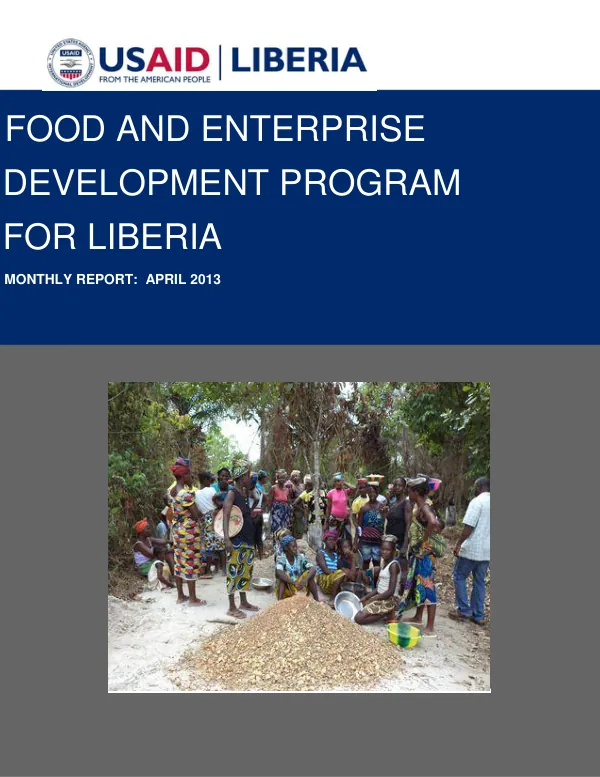
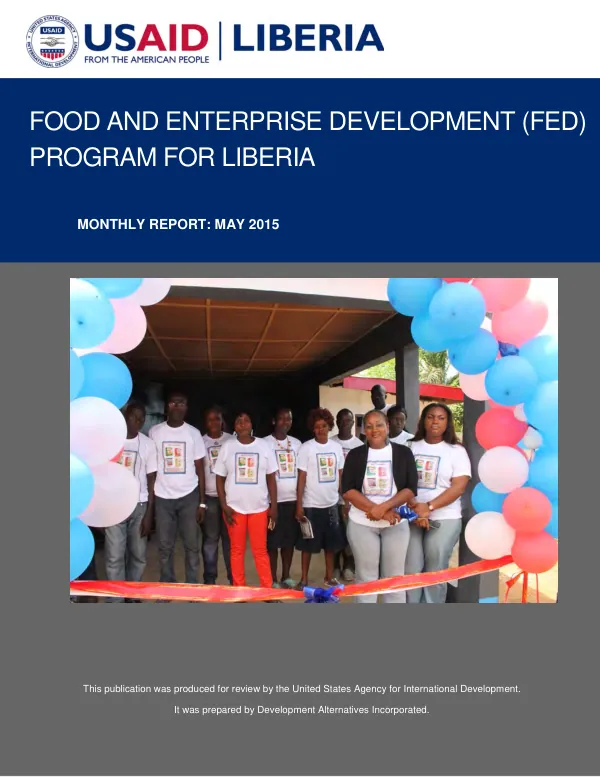
Food and Enterprise Development (FED) Program for Liberia: Bi-Weekly Report: December 1-15, 2012
Sign inDEVELOPMENT ALTERNATIVES, INC./FINNET
Food and Enterprise Development (FED) Program for Liberia: Bi-Weekly Report: December 1-15, 2012
The Food and Enterprise Development (FED) Program for Liberia is a USAID-funded initiative that began in September 2011.
2012 · 15 pages
Sign in to readA free account is required to download.
Abstract
The program aims to help the government of Liberia achieve food security by building an indigenous incentive structure that assists a range of agricultural stakeholders to adopt commercial approaches and actively incorporates women and youth. This incentive structure is being built upon improved technologies for productivity and profitability, expanded and modernized input supply and extension systems, commercial production, marketing, and processing, enterprise services, and workforce and human capacity development. FED's activities work with the Ministry of Agriculture (MoA) and the private sector to link communities to extension services, agricultural inputs, improved technologies, processing services, market information, transportation, credit, and appropriate education, training, and business development services. The program focuses on six counties: Bong, Lofa, Nimba, Grand Bassa, Montserrado, and Margibi, which are part of expanding development corridors that aim to foster intra- and inter-county commerce, and improve food availability and access for all Liberians. FED's methodology is market-led, value chain-driven, and continuously dedicated to indigenous capacity building, with a specific focus on benefiting Liberia's women and youth. The program's approach aims to be collaborative, catalytic, and driven by the goals and objectives of partner clients. It will lead to increases in incomes for rural households, new employment opportunities for Liberians, increased access to food, and improved household dietary diversity scores for food-insecure Liberians. From December 1-15, 2012, FED carried out several activities, including agro-dealers' capacity building. A training session was held for 12 agro-dealers, 4 District Agricultural Officers, 2 FED Extension Officers, 8 community-based facilitators, and 8 representatives from 5 farmer cooperatives on agro-input supply at FED's office in CARI, Bong County. The training focused on establishing sales points at County and District levels, conducting rapid input demand assessments, running small agro-input shops, and demonstrating the use of fertilizers and agro-chemicals to farmers. The objectives of agro-dealers capacity building include learning about the inputs recommended for the promotion of the 4 value chains promoted by FED, skills development on how to use them, establishment and management of a small sale point, and preparation and use of extension/promotion materials using local materials and local languages. In 2013, FED is targeting 300 smallholder farmers adopting and using recommended agro-inputs on their rice fields, 600 on their cassava fields, 267 vegetable growers accessing improved inputs, and 96 goat farmers using recommended small livestock inputs. FED is implemented by Development Alternatives, Inc. (DAI), supported by subcontracts with the Cadmus Group, International Fertilizer Development Center, Louisiana State University, and Winrock International. The program's geographic reach is focused on six counties in Liberia, with a goal of expanding market linkages, leading to substantial income and job growth, and increases in the production, processing, marketing, and nutritional utilization of rice, cassava, vegetables, and goats.