USAID DEC
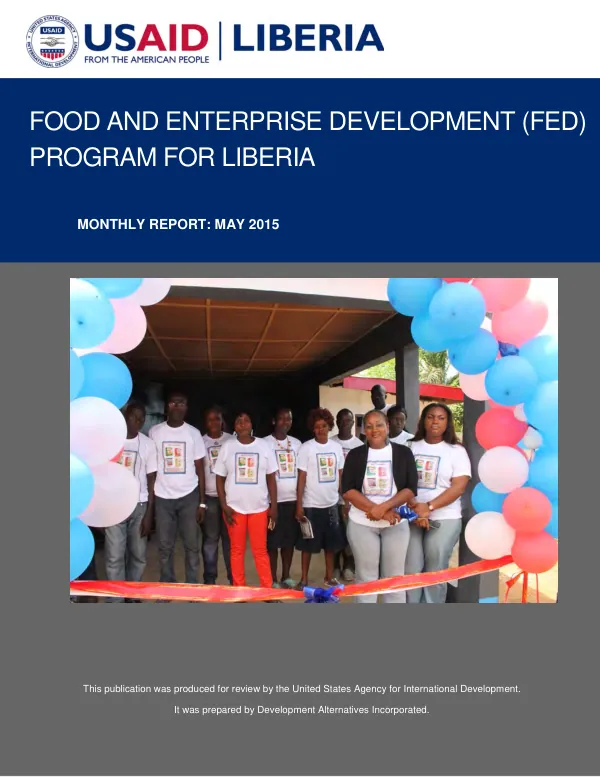
Monthly Report: May 2015 - Food and Enterprise Development (FED) Program for Liberia
Sign inDEVELOPMENT ALTERNATIVES, INC./FINNET
Monthly Report: May 2015 - Food and Enterprise Development (FED) Program for Liberia
The Food and Enterprise Development (FED) Program for Liberia is a USAID-funded initiative aimed at improving agricultural productivity and profitability, stimulating private sector growth, and building local technical and managerial human resource capability.
2015 · 36 pages
Sign in to readA free account is required to download.
Abstract
The program is implemented by Development Alternatives Incorporated (DAI) and is designed to run from 2011 to 2016. The program is divided into four components: Component One focuses on increasing agricultural productivity and profitability through the development of the rice, cassava, horticulture, and goat value chains. Task 1A aims to increase productivity and profitability of the rice value chain, while Task 1B targets the cassava value chain. Task 1C focuses on the horticulture value chain, and Task 1D targets the goat value chain. Subtasks under Component One include special studies, data collection system development, improved access to agricultural inputs, agricultural extension support, youth in agribusiness, and improving human nutrition. Component Two aims to stimulate private sector growth and investment by creating a policy enabling environment for private sector growth. Task 2 focuses on policy enabling environment for private sector growth, with subtasks including access to financing, access to business development support services and enterprise service centers, and women participation in agribusiness. Component Three focuses on building local technical and managerial human resource capability through training and capacity building programs. Component Four includes cross-cutting activities such as communications, knowledge management, environmental compliance, and monitoring and evaluation. The program has made significant progress in its first year, with notable achievements including the distribution of fertilizer to farmers, the installation of rain shelters in goat production intensification sites, and the training of village and group agents in business planning and management. The program has also established partnerships with local institutions, including the University of Liberia and the Booker Washington Institute, to provide training and capacity building programs for farmers and agribusiness entrepreneurs. The program's geographic focus is on Liberia, with a particular emphasis on the counties of Grand Bassa, Lofa, and Nimba. The program's timeframes are from 2011 to 2016, with a focus on achieving specific outcomes and impact by the end of the program period. The program's recommendations include the need for continued support for the development of the agricultural sector, the importance of building local technical and managerial human resource capability, and the need for a policy enabling environment for private sector growth. The program also recommends the establishment of a market information system to provide farmers and agribusiness entrepreneurs with timely and accurate market information. Overall, the FED Program for Liberia is a comprehensive initiative aimed at improving agricultural productivity and profitability, stimulating private sector growth, and building local technical and managerial human resource capability. The program has made significant progress in its first year and is well-positioned to achieve its outcomes and impact by the end of the program period.