DEVELOPMENT ALTERNATIVES, INC./FINNET
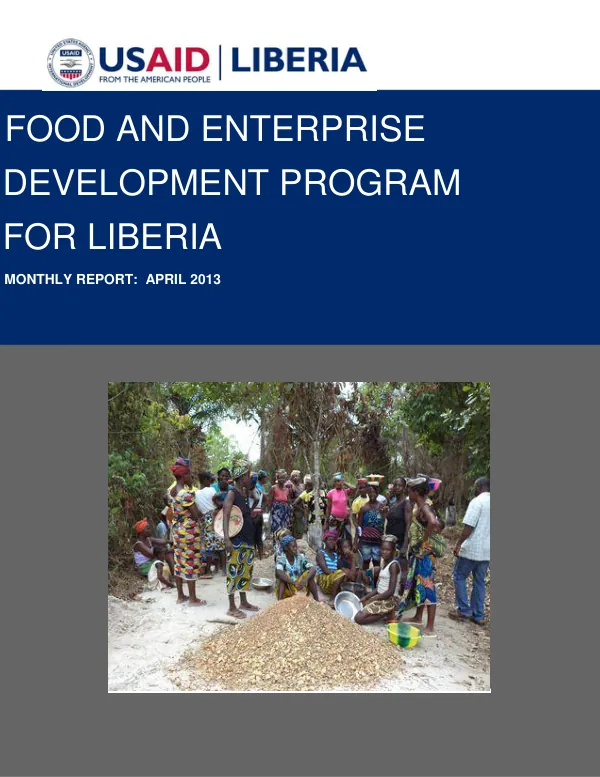
Food and Enterprise Development Program for Liberia Monthly Report April 1-30, 2013
The Food and Enterprise Development Program for Liberia is a USAID-funded initiative that began in September 2011.
2013 · 38 pages
Sign in to readA free account is required to download.
Abstract
The program aims to help the government of Liberia and the country achieve food security by building an indigenous incentive structure that assists a range of agricultural stakeholders to adopt commercial approaches. This incentive structure is built upon improved technology for productivity and profitability, expanded and modernized input supply and extension systems, commercial production, marketing, and processing, enterprise services, and workforce development. FED works with the Ministry of Agriculture (MoA) and the private sector to link communities to agricultural inputs, extension services, nutritious food products, processing services, market information, transportation, credit, and education and training services. The program targets six counties: Bong, Lofa, Nimba, Grand Bassa, Montserrado, and Margibi, with a focus on regional development corridors that foster intra- and inter-county commerce. FED's methodology is market-led, value chain-driven, and dedicated to indigenous capacity building, with a focus on benefiting Liberia's women and youth. The program aims to increase incomes for rural households, create new employment opportunities for Liberians, expand access to food, and improve household dietary diversity scores for food-insecure Liberians. During the month of April, FED implemented various activities, including the rollout of rice production activities, preparation of sites for Urea Deep Planting (UDP) field trials, and construction of parboiling floors and goat shelters. The program also conducted a Training of Trainers (TOT) Workshop in rice production across Nimba, Bong, and Grand Bassa Counties, which brought together 25 technicians from four NGOs. The NGO trainees were trained in best practices in rice production and water management and will provide on-farm training to 5,341 farmers across four counties. In addition, eight artisans were trained in the fabrication of parboiling drums and tanks, and 25 masons were trained in the construction of drying floors. The masons will provide the service for future construction of additional drying floors in various FED-assisted sites. Eight drying floors were constructed and parboiling tanks were fabricated, with demonstration of the use of these post-harvest technologies carried out by STTA Dr. Rama Rao Vellanki. FED also supported the first annual MoCI MSME 2013 Conference and Trade Fair, which took place from April 24 to 26. The conference and trade fair aimed to promote the development of micro, small, and medium enterprises (MSMEs) in Liberia and to provide a platform for entrepreneurs to showcase their products and services. The program's implementation is led by five partners, including Development Alternatives, Inc. (DAI), Winrock International, International Fertilizer Developmental Center (IFDC), Louisiana State University, and The Cadmus Group. FED's approach aims to be collaborative, catalytic, and driven by the goals and objectives of its partner clients, with a focus on increasing agricultural productivity and profitability, stimulating private enterprise, and building local human capacity.