USAID DEC
Food and Enterprise Development (FED) Program for Liberia Monthly Report: October 2012
Sign inDEVELOPMENT ALTERNATIVES, INC./FINNET
Food and Enterprise Development (FED) Program for Liberia Monthly Report: October 2012
The Food and Enterprise Development (FED) Program for Liberia is a USAID-funded initiative that began in September 2011.
2012 · 39 pages
Sign in to readA free account is required to download.
Abstract
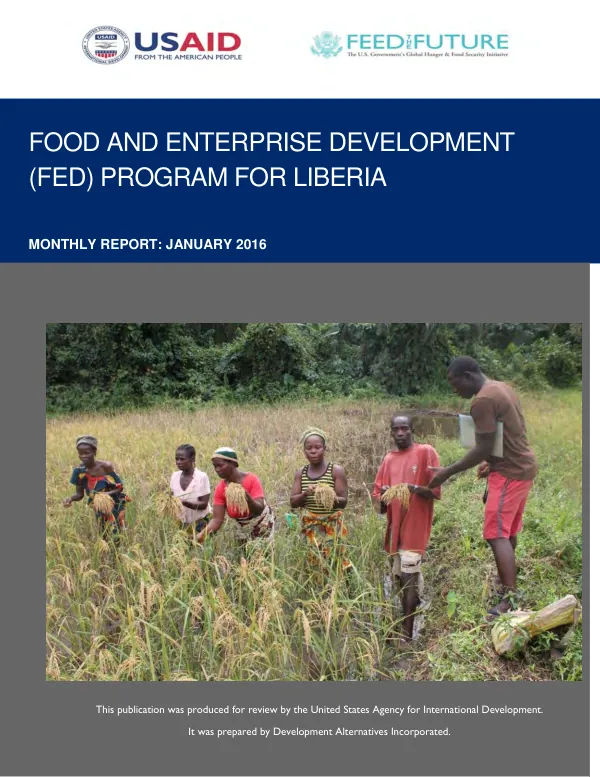
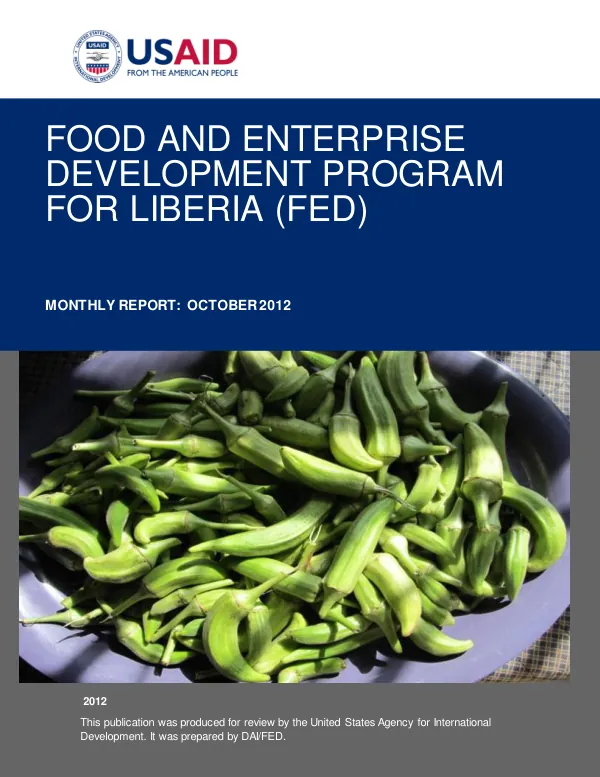
The program aims to help the government of Liberia and the country achieve food security by building an indigenous incentive structure that assists a range of agricultural stakeholders to adopt commercial approaches. This incentive structure will be built upon improved technology for productivity and profitability, expanded and modernized input supply and extension systems, commercial production, marketing, and processing, enterprise services, and workforce development. FED's activities will work with the Ministry of Agriculture (MoA) and the private sector to link communities to agricultural inputs, extension services, nutritious food products, processing services, market information, transportation, credit, and appropriate education, training, and enterprise services. The program will target six counties: Bong, Lofa, Nimba, Grand Bassa, Montserrado, and Margibi, with a focus on regional development corridors that foster intra- and inter-county commerce. FED's methodology is market-led, value chain-driven, and dedicated to indigenous capacity building, with a specific focus on benefiting Liberia's women and youth. The program aims to lead to increases in incomes for rural households, new employment opportunities for Liberians, increased access to food, and improved household dietary diversity scores for food-insecure Liberians. In October 2012, FED observed damage to rice crops in Bong and Nimba counties due to diosis, African rice gall midge, and other pests. Insect damage was also observed at the NCCC demonstration site, while nutrient deficiency and water management problems were identified as main issues. In Bong County, damage to NERICA L19 was caused by insects, while uncontrolled weed growth was a problem at the Zeansue site. In Grand Bassa County, weed growth was a problem at the Yarmah Town site. FED's implementation is led by seven partners, including Development Alternatives, Inc. (DAI), Winrock International, International Fertilizer Developmental Center (IFDC), Samaritan's Purse, Louisiana State University, The Cadmus Group, and the Center for Development and Population Activities. The program's activities are focused on increasing agricultural productivity, stimulating private enterprise, and building local human capacity. In October 2012, FED's activities included input supply system interventions, increased production and profitability of quality rice, and peri-urban vegetable production. The program also provided targeted technical support to commercial buyers and lead producers, and increased enterprise registration and local government engagement. FED's use of ICTs in stimulating Liberian agri-business was also a key focus area. FED's environmental compliance monitoring and reporting, as well as its monitoring and evaluation activities, are ongoing. The program's market development fund is also being utilized to support the growth of small and medium enterprises in Liberia.