DAI
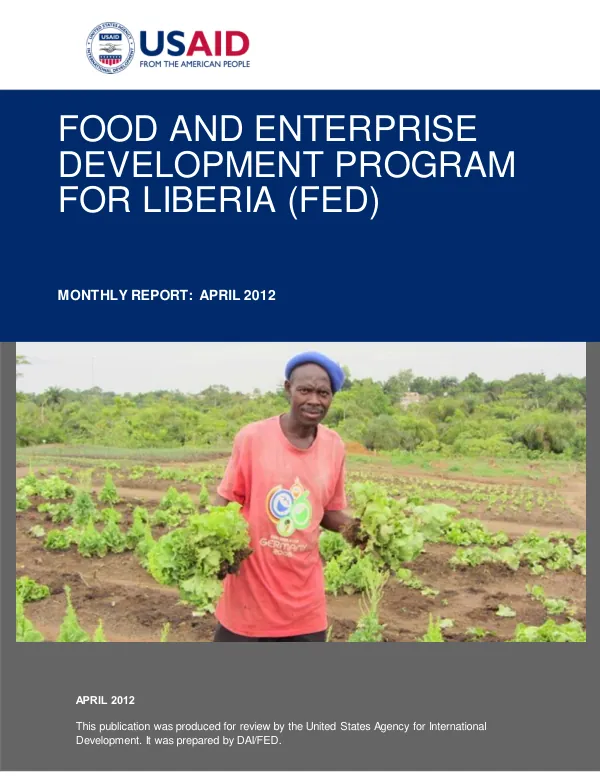
Food and Enterprise Development (FED) Program for Liberia Monthly Report April 2012
The Food and Enterprise Development (FED) Program for Liberia is a USAID-funded initiative aimed at increasing agricultural productivity and profitability, stimulating private enterprise growth, and building local technical and managerial human resources.
2012 · 26 pages
Sign in to readA free account is required to download.
Abstract
The program is being implemented in three components: Component-1, Component-2, and Component-3. Component-1 focuses on increasing agricultural productivity and profitability, and improving human nutrition. Task 1.3 Input Supply System Interventions involves improving access to quality agro-inputs and testing and introducing new technologies. During the month of April 2012, farmers' cooperatives and associations were identified in Lofa and Nimba Counties, and sites for FED activities were selected in Bong, Nimba, Lofa, and Grand Bassa. The program will work in the rice and cassava value chains in these counties. A rapid assessment of irrigation layout and crop management in the lowlands was conducted in Lofa County. The findings suggest that irrigation structures are poorly managed, leading to poor water control, water logging, iron toxicity, and nitrogen deficiency. Crop yields are still very low due to poor water, weed, crop disease, and soil fertility management in the lowlands. Extension support is still weak, and international NGOs have had difficulties providing support to farmers. Component-2 focuses on stimulating private enterprise growth and investment. Task 2.2 Access to Finance involves improving access to financial services for small and medium-sized enterprises (SMEs). Task 2.4 Use of ICTs in Stimulating Liberian Agri-Business involves promoting the use of information and communication technology (ICT) to stimulate agri-business growth. Component-3 focuses on building local technical and managerial human resources. Task 3.1 Creating Centers of Excellence involves establishing centers of excellence in agriculture and agri-business. The program has conducted training for Extension Agents in crop planning, input procurement, and testing of soil water. A treadle irrigation demonstration was conducted in Nimba County, and a 2-day Business Management Skills training was conducted in Monrovia for SMEs working in the cassava value chain. The Market Development Fund (MDF) Acting Manager, Jessica Stretz, arrived in Monrovia to oversee the day-to-day operations and management of the MDF. The FED IT Department successfully set up two field offices in Grand Bassa and Lofa counties. The program has also established a network of farmers' cooperatives and associations in Lofa and Nimba Counties. The program has made significant progress in implementing its activities, including training for Extension Agents, conducting demonstrations on integrated soil fertility management and urea deep placement, and establishing a network of farmers' cooperatives and associations. However, challenges remain, including poor management of irrigation structures, low crop yields, and weak extension support.